About 119 minutes
Kelly of the Foreign Legion: Letters of Légionnaire Russell A. Kelly — A Closer Reading
World Events
27,153 recorded words. 1 minutes difference from this book's estimate.
View Gutenberg source #57453
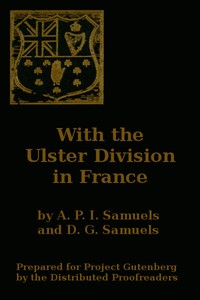
The catalog record for With the Ulster Division in France A Story of the 11th Battalion Royal Irish Rifles (South Antrim Volunteers), From Bordon to Thiepval. — Reading Notes provides practical reading context through 27,576 words, 2 hr estimated reading time, and 5 detected text sections.
The text analysis averages about 15.5 words per sentence, while the detected sections provide another way to judge how the source is divided.
Project Gutenberg metadata also associates the work with “World War, 1914-1918 -- Regimental histories -- Great Britain,” connecting these edition facts with the source record’s subject description.
Explore this collection
These alternatives are selected using recorded categories and estimated reading time.
About 119 minutes
World Events
27,153 recorded words. 1 minutes difference from this book's estimate.
View Gutenberg source #57453About 126 minutes
World Events
28,908 recorded words. 6 minutes difference from this book's estimate.
View Gutenberg source #48301About 133 minutes
World Events
30,411 recorded words. 13 minutes difference from this book's estimate.
View Gutenberg source #51222Search stored excerpts and compare books → Choose by your preferences →
Choices use stored catalog measurements. Estimates vary with reading speed. A shared category is a catalog label, not a claim that two books have the same argument or literary quality.
Search reads excerpt text stored with this catalog and links to its associated Gutenberg record. The connection is stored in the site database; this tool does not recheck that every excerpt is word-for-word identical to that external record. Excerpt search does not cover every chapter and does not verify historical publication dates.
Catalog snapshot checked: 2026-09-25. Coverage: 91 public books, 91 available source excerpts.
Read the complete public-domain text at its original source.
Read on Project GutenbergThe preface immediately establishes this book as a posthumous compilation: Captain A. P. I. Samuels kept a diary and collected materials at the front, intending to publish an account of the Ulster Division, but was killed in action on September 24, 1916. His papers were taken up by D. G. Samuels, who frames the work as a limited record, not a full history. This origin shapes the reader's expectations—the narrative is rooted in personal observation and unit-level detail, not strategic overview. The dedication “to the people of Ulster” and the epigraph from Tennyson’s “The Passing of Arthur” signal a tone of commemorative pride and elegy, which colors the account of the battalion’s journey from Bordon to Thiepval.
The excerpts reveal that the book is organized in four parts, tracking the battalion from training in England to the Somme battlefield. The preface notes that the account is “compiled from the diary of Captain Samuels, supplemented by the records he was able to obtain.” This means the narrative likely follows a chronological, episodic pattern rather than a thematic one. Readers should expect shifts in pace: early sections may cover camp life, drills, and embarkation, while later sections concentrate on combat. The diary origin also explains the presence of specific dates and place names (e.g., Bordon, Thiepval) and the occasional inclusion of quoted dialogue or prisoner statements, as seen in the Somme excerpt.
The title’s phrase “From Bordon to Thiepval” maps the battalion’s trajectory. Bordon, a camp in Hampshire, represents the pre-deployment phase; Thiepval, a village on the Somme, marks the climax of the narrative. The middle excerpts—though not fully provided—likely cover the unit’s arrival in France, trench familiarization, and minor actions. The later excerpt, describing the July 1, 1916 attack, shows a stark shift in tone: the language becomes more graphic and urgent. Phrases like “they fell in hundreds” and “the trees were slashed and cut till nothing but bare stumps remained” contrast with the more measured, administrative voice of the preface. This transition is a key structural element, guiding the reader from preparation to catastrophe.
The longest excerpt focuses on the first day of the Battle of the Somme. It describes the advance of the 11th Battalion and the wider Ulster Division, noting that within an hour and a half they took five lines of German trenches and captured several hundred prisoners. However, the account quickly turns to the cost: enfilading machine-gun fire from Thiepval village, the exposure of the left flank when neighboring divisions failed to take Beaumont Hamel, and the eventual order to retire. The narrative includes specific details: prisoners reported that bombardment prevented them from getting water; the 12th Battalion Royal Irish Rifles suffered severely; a counter-attack on Sunday afternoon retook the lost lines. The passage ends with the recognition that the position became an untenable salient. This section functions as the book’s dramatic core, and its density of detail rewards close reading.
The excerpts show a dual voice: the late captain’s diary entries and the editor’s framing. The preface uses formal, commemorative language (“unspeakable grief,” “renown to our Province”). The battle narrative, however, mixes reported speech (“‘Not at all,’ said the Ulsterman”) with stark observation (“the wounded were shot through and through on the ground as they lay”). The inclusion of a prisoner’s remark about the bombardment’s effect adds a rare German perspective. The editor occasionally interjects with broader context, such as the tactical explanation of the salient. This blend of personal testimony and explanatory commentary gives the book a hybrid quality—part memoir, part unit history. Readers should note which passages are likely from the diary (immediate, sensory) and which are later additions (analytical, retrospective).
Because the book is compiled from a diary and closes with the Somme, it does not cover the remainder of the war. The narrative is necessarily incomplete, ending in mid-1916. Readers interested in the full arc of the Ulster Division should consult broader histories. However, for a ground-level view of one battalion’s experience—from training to the first day of the Somme—this account offers vivid, specific detail. Pay attention to the shifts between the captain’s raw observations and the editor’s framing, as they reveal how the story was shaped after the fact.
Reading the diary-like shift from Bordon’s drill squares to Thiepval’s raw chalk brought back my grandfather’s silence about the Somme. He never spoke of it, but I felt the weight. A Surgeon in Arms — Background and Themes gave me a similar ache—the professional calm over the bloody bedroll. Both books hold the same quiet, awful truth: men endure, then carry it home.
A brief reflection can help important ideas stay with you longer.