About 250 minutes
The Mosquito Fleet — A Closer Reading
World Events
57,294 recorded words. 8 minutes difference from this book's estimate.
View Gutenberg source #65550
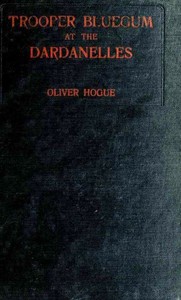
Before opening Trooper Bluegum at the Dardanelles Descriptive Narratives of the More Desperate Engagements on the Gallipoli Peninsula — Reading Companion, the edition data offers a quick orientation: 55,432 words, 4 hr 2 min estimated reading time, and 7 detected text sections.
The text analysis averages about 17.4 words per sentence, while the detected sections provide another way to judge how the source is divided.
Project Gutenberg metadata also associates the work with “World War, 1914-1918 -- Personal narratives, Australian,” connecting these edition facts with the source record’s subject description.
Explore this collection
These alternatives are selected using recorded categories and estimated reading time.
About 250 minutes
World Events
57,294 recorded words. 8 minutes difference from this book's estimate.
View Gutenberg source #65550About 261 minutes
World Events
60,018 recorded words. 19 minutes difference from this book's estimate.
View Gutenberg source #46037About 264 minutes
World Events
60,617 recorded words. 22 minutes difference from this book's estimate.
View Gutenberg source #57307Search stored excerpts and compare books → Choose by your preferences →
Choices use stored catalog measurements. Estimates vary with reading speed. A shared category is a catalog label, not a claim that two books have the same argument or literary quality.
Search reads excerpt text stored with this catalog and links to its associated Gutenberg record. The connection is stored in the site database; this tool does not recheck that every excerpt is word-for-word identical to that external record. Excerpt search does not cover every chapter and does not verify historical publication dates.
Catalog snapshot checked: 2026-09-25. Coverage: 91 public books, 91 available source excerpts.
Read the complete public-domain text at its original source.
Read on Project GutenbergOliver Hogue, writing as Trooper Bluegum, structures his account of the Gallipoli campaign around a series of stark contrasts. The narrative repeatedly moves between the front lines and moments of relief—a hospital ship, a bath, a view of the Aegean—creating a rhythm that mirrors the soldier's experience of war as a succession of intense, disorienting shifts. Hogue's prose is marked by a deliberate oscillation between lyrical description and blunt, unadorned statements of horror, as when he moves from admiring the sunset to stating, 'I have taken up my rifle and gone forth to kill men.' This structural pattern, rather than a chronological battle log, shapes the reader's understanding of the campaign's psychological toll.
The most pronounced structural device in the excerpts is the juxtaposition of 'heaven' and 'hell.' Hogue describes a hospital ship as 'just like heaven,' with nurses as 'ministering angels,' and then returns to 'that hell upon the earth.' This binary is not merely rhetorical; it organizes the narrative's movement between spaces of safety and danger. The contrast is reinforced by sensory details: the smooth sea and perfect weather of the ship versus the 'air full of bursting shells' on shore. Hogue even quotes General Sherman's 'All war is hell' to underscore the point. This repeated oscillation gives the account a moral and emotional geography, where the reader is constantly reminded of the fragility of respite.
Hogue frequently turns to the landscape as a counterpoint to violence. He describes 'Braund's Hill admiring the sunset views' and the islands of the Aegean 'floating on the edge of a gorgeous canvas of shimmering gold.' These moments of natural beauty are deliberately set against the 'blot upon God's beauties' that war represents. The dawn and sunset become recurring markers, framing the day's fighting. Yet the landscape is also weaponized: the hills are reshaped by shellfire, and the enemy watches from the other side. This dual use of setting—as both refuge and battlefield—creates a tension that runs through the narrative, grounding abstract horror in a specific, beautiful, and deadly place.
Hogue's narrative voice shifts between the personal and the collective. He uses the first person for immediate experiences—'I never felt better in my life. My appetite was of the best'—but also speaks for the unit: 'I have seen our boys fall like ninepins.' This movement between individual observation and group identity is a structural feature of the text. The author is both a participant and a reporter, a duality reflected in the book's origin as newspaper articles. The voice also carries a self-deprecating humor, as when he 'longed for a broken arm or leg' to stay on the hospital ship, which humanizes the narrator without diminishing the gravity of the events.
The excerpts show that the book's progression is driven not by a single battle but by a series of movements: from ship to shore, from trench to hospital, from observation to action. Hogue describes leaving the hospital ship, returning to the front, and then immediately shifts to the strategic situation—'On the other side were forty thousand Turks.' This quick scene change mirrors the soldier's lack of control over his environment. The narrative also moves between scales: from the personal detail of a bath to the broadside of the Queen Elizabeth. This constant shifting keeps the reader off-balance, replicating the disorientation of war itself.
Readers approaching Trooper Bluegum at the Dardanelles should attend to how Hogue uses structure and imagery to convey the psychological reality of the Gallipoli campaign. The book is less a chronological history than a series of vivid, emotionally charged vignettes. Pay attention to the moments of stillness—a sunset, a conversation with a nurse—as they are as essential to the narrative as the descriptions of combat. Hogue's voice, at once personal and representative, offers a unique window into the soldier's experience of war as a series of jarring transitions between the sublime and the horrific.
I remember when Trooper Bluegum at the Dardanelles first came to my desk, its pages still smelling of salt and smoke. Years later, holding The World Crisis, Volume 1 (of 6) — Edition Insights, I found the same somber tide—Churchill’s strategic sorrow echoing Hogue’s soldier’s weariness, two voices sharing one dark, patient silence about what war really costs.
Your answers remain private and are stored only in this browser.