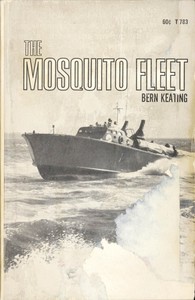
Bern Keating opens The Mosquito Fleet with a pointed contrast: the dramatic escape of General Douglas MacArthur from the Philippines in March 1942, a moment that lifted American spirits after months of disaster, and the unglamorous reality of the PT boats that would later serve in his return. The book, based on action reports and squadron histories, does not romanticize its subject. Instead, it presents PT boats as vessels that were often misunderstood, underappreciated, and caught in the middle of larger naval forces—sometimes even fired upon by their own allies.
Friendly Fire and Fog of War
A recurring pattern in the excerpts is the confusion of battle, where PT boats are as likely to be shot at by friendly destroyers as by the enemy. Keating recounts an incident off Bizerte where American PTs, arriving to engage German E-boats, were taken under fire by British destroyers who mistook them for the enemy. The PT skippers had to dodge Allied shells while attacking the Germans. One lieutenant burst through his own smoke screen, raked an E-boat with machine guns, and vanished back into the smoke before the enemy could retaliate. The destroyers chased the PTs for an hour, firing starshells and main battery salvos—fortunately with poor aim. Days later, a destroyer skipper apologized, explaining he had ventured into the PT patrol area seeking action. The episode underscores the tactical friction between different naval branches and the chaotic conditions under which PT crews operated.
The Stepchild Treatment at Bizerte
Keating documents how PT squadrons were repeatedly pushed aside by larger naval forces. When Squadron Fifteen arrived at the newly captured port of Bizerte, they cleaned up a hangar and scrounged spare parts, only to be evicted as larger ships arrived. As one veteran put it, “We cleaned up half the buildings in Bizerte… As fast as we made a place presentable, we were kicked out.” The PT crews ended up with a fraction of their original space, fighting “tooth and nail” for every inch. This pattern of being treated as second-class assets is a thread throughout the narrative, from the Pacific to the Mediterranean. Even the first PT to enter Bizerte—Lieutenant O’Brien’s boat, which tied up hours after the port fell—was asked to move aside by a newsreel photographer who wanted to film British landing ships as “the first Allied craft to enter.” O’Brien complied, but the slight was not forgotten.
Improvisation and Ingenuity Under Fire
Despite being overshadowed, PT crews adapted with resourcefulness. In the Mediterranean, when American PTs were fitted with radar but British boats were not, the two fleets developed a system of radio signals to vector British boats to radar-detected targets for coordinated attacks. Keating also notes a bizarre hoax by British secret agents to mislead the enemy about Allied landing sites—a scheme he calls “worthy of the cheapest dime novel.” The book’s reliance on action reports and veteran diaries gives these details a ground-level authenticity. The PTs’ small size and speed forced crews to rely on surprise, smoke screens, and close-range engagements, as when Lieutenant Clifford used his own smoke to conceal his attack on German E-boats. These episodes highlight a war fought not by grand strategy alone, but by quick thinking and mechanical improvisation.
Keating’s narrative is built from official records and personal accounts, giving equal weight to the bureaucratic frustrations of base-cleaning and the adrenaline of night engagements. Readers should expect a work that is less a sweeping history than a mosaic of small-boat warfare, where the line between ally and enemy sometimes blurred in the dark. The appendices—listing specifications, losses, and decorations—offer a sobering counterpoint to the anecdotes of ingenuity and survival.
Years at this desk, and I still find myself lingering over The Mosquito Fleet, those swift little boats and their restless courage. The same unease, the same quiet honor, seems to live in that old regimental history, the 1914-1919 one, where weary men held ground without spectacle. It is a kinship of endurance, I think. History of the 1/4th Battalion Duke of Wellington's (West Riding) Regiment, 1914-1919. — Background and Themes sits beside it now, and neither demands a word from me.