About 135 minutes
The Somme, Volume 2. The Second Battle of the Somme (1918) (Amiens, Montdidier, Compiègne) — Reading Companion
World Events
30,891 recorded words. 0 minutes difference from this book's estimate.
View Gutenberg source #53762
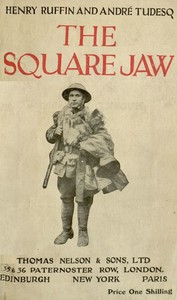
For The Square Jaw — Story, Setting & Ideas, the stored edition analysis reports 30,821 words, 2 hr 15 min estimated reading time, and 4 detected text sections.
The text analysis averages about 17.8 words per sentence, while the detected sections provide another way to judge how the source is divided.
Project Gutenberg metadata also associates the work with “World War, 1914-1918 -- Great Britain,” connecting these edition facts with the source record’s subject description.
Explore this collection
These alternatives are selected using recorded categories and estimated reading time.
About 135 minutes
World Events
30,891 recorded words. 0 minutes difference from this book's estimate.
View Gutenberg source #53762About 133 minutes
World Events
30,411 recorded words. 2 minutes difference from this book's estimate.
View Gutenberg source #51222About 137 minutes
World Events
31,314 recorded words. 2 minutes difference from this book's estimate.
View Gutenberg source #51523Search stored excerpts and compare books → Choose by your preferences →
Choices use stored catalog measurements. Estimates vary with reading speed. A shared category is a catalog label, not a claim that two books have the same argument or literary quality.
Search reads excerpt text stored with this catalog and links to its associated Gutenberg record. The connection is stored in the site database; this tool does not recheck that every excerpt is word-for-word identical to that external record. Excerpt search does not cover every chapter and does not verify historical publication dates.
Catalog snapshot checked: 2026-09-25. Coverage: 91 public books, 91 available source excerpts.
Read the complete public-domain text at its original source.
Read on Project GutenbergThe opening chapter, 'The Impromptu Victory,' immediately establishes the book's method: a correspondent on the Ancre front on 13 November 1916 describes the battle not through official reports but through the sensory details of the moment—'the thunder of the guns and the magic glow of fires.' The narrator insists that bulletins 'leave you cold' unless read on the field, where 'a heady, irresistible joy' seizes the army. This insistence on being present, on capturing the atmosphere rather than the strategic overview, shapes the entire work.
The authors, Henry Ruffin and André Tudesq, were French journalists, and the book is a translation of their dispatches. The English edition, published by Thomas Nelson & Sons, preserves the immediacy of the original French perspective on British and Allied operations.
The narrator's language oscillates between professional detachment and visceral involvement. In the Ancre chapter, he notes that 'the bell of the telephone follows, strangely, the measure of our heart-beats,' a simile that personifies technology as a participant in the emotional rhythm of battle. Elsewhere, he quotes a colonel who calls the victory 'an impromptu,' and comments: 'The word is a picture. It is absolutely right.' This habit of pausing to remark on a phrase reveals a writer self-consciously aware of language as a tool for conveying war's peculiar texture.
Yet the narrator also maintains a reporter's distance. He refers to 'our Allies' rather than 'us,' and describes the British soldiers as 'they'—a subtle marker of his French nationality. This dual perspective, both inside the scene and outside the national identity of the troops, gives the prose a layered, observational quality.
The chapter on Arras offers a striking example of how war reorganizes space. The narrator notes that the town's squares have been renamed 'Place 1, 2, 3, and so on,' erasing the historic names. Notice boards instruct civilians 'not to move about except upon the footpaths and hugging the walls,' and warn that talking about military matters 'may come under suspicion.' The bureaucratic language of control contrasts sharply with the physical ruin: 'not one house is to be seen that has not received its wound, more or less mortal.'
The description of an elderly washerwoman who refuses to leave—'A little sooner, a little later. What does it matter at my age?'—grounds the abstraction of destruction in a specific voice. Her grandson was killed 'close by here in 1914,' and she points to the German lines: 'The Boches are there.' The narrator lets her speak without commentary, allowing her matter-of-fact grief to stand as its own testimony.
Throughout the excerpts, the authors attend to the mundane details that define existence at the front. In the Ancre section, despatch riders bring reports 'through the ruts and mud of the roads,' and the 'feverish joy' of victory is registered in the men singing in their quarters. The weather is a constant presence: fog and drizzle obscure the morning attack, and later, in Arras, rain and wind finish the work of the guns, causing buildings to 'rust and crumble.'
The narrator also notes the peculiarities of military organization. In Arras, the steel helmet and gas mask are obligatory, and civilians are told not to concern themselves with military matters. These details, presented without editorializing, build a picture of a world where every aspect of life is regulated by the proximity of the enemy. The phrase 'a civilian warned is a civilian armed' is offered as a 'novel example of organisation and forethought,' with a hint of irony.
The book is divided into four parts, each composed of short, titled chapters that read like dispatches filed from different sectors. Part I covers the Battle of the Ancre; Part II introduces 'The Square Jaws' (a term not explained in the excerpts); Part III moves to the Armies of the North, including the Canadians; Part IV offers 'Impressions of No Man's Land.' This structure mirrors the correspondent's movement along the front, shifting from set-piece battles to vignettes of daily life.
The chapters vary in length and focus: some are datelined ('The Ancre Front, 13th November'), others are portraits of individuals or places. The effect is cumulative rather than linear. The reader is not given a continuous narrative but a series of snapshots, each anchored by a specific observation or encounter. This fragmentation reflects the nature of war reporting, where the correspondent sees only pieces of a larger picture.
Readers should approach The Square Jaw as a collection of frontline impressions rather than a comprehensive history. The authors' strength lies in their eye for detail and their willingness to let scenes speak for themselves. Pay attention to the small moments—the telephone that beats like a heart, the washerwoman pointing across the road—because it is there that the book captures something of the war's human reality. The translation occasionally feels stiff, but the original French perspective on British operations offers a valuable counterpoint to English-language accounts.
Rain kept tapping the window while I read about Arras, the strange quiet after the guns. What struck me most wasn’t the mud or the noise, but how people held onto ordinary routines amid chaos. That thread led me, almost without thinking, to a different voice—a nun’s—covering the same uncanny persistence in Belgium. From Convent to Conflict; Or, A Nun's Account of the Invasion of Belgium — Context and Discussion sat on my shelf, and the rain seemed to ask for it.
Your answers remain private and are stored only in this browser.