About 147 minutes
From Convent to Conflict; Or, A Nun's Account of the Invasion of Belgium — Context and Discussion
World Events
33,764 recorded words. 0 minutes difference from this book's estimate.
View Gutenberg source #56299
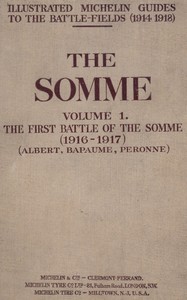
Before opening The Somme, Volume 1. The First Battle of the Somme (1916-1917) (Albert, Bapaume, Péronne) — Inside the Classic, the edition data offers a quick orientation: 33,608 words, 2 hr 27 min estimated reading time, and 12 detected text sections.
The text analysis averages about 17.6 words per sentence, while the detected sections provide another way to judge how the source is divided.
Project Gutenberg metadata also associates the work with “Somme, 1st Battle of the, France, 1916,” connecting these edition facts with the source record’s subject description.
Explore this collection
These alternatives are selected using recorded categories and estimated reading time.
About 147 minutes
World Events
33,764 recorded words. 0 minutes difference from this book's estimate.
View Gutenberg source #56299About 146 minutes
World Events
33,505 recorded words. 1 minutes difference from this book's estimate.
View Gutenberg source #65761About 142 minutes
World Events
32,491 recorded words. 5 minutes difference from this book's estimate.
View Gutenberg source #52656Search stored excerpts and compare books → Choose by your preferences →
Choices use stored catalog measurements. Estimates vary with reading speed. A shared category is a catalog label, not a claim that two books have the same argument or literary quality.
Search reads excerpt text stored with this catalog and links to its associated Gutenberg record. The connection is stored in the site database; this tool does not recheck that every excerpt is word-for-word identical to that external record. Excerpt search does not cover every chapter and does not verify historical publication dates.
Catalog snapshot checked: 2026-09-25. Coverage: 91 public books, 91 available source excerpts.
Read the complete public-domain text at its original source.
Read on Project GutenbergThis volume, published by Michelin & Cie in 1919, is a hybrid document: part battlefield guide for motorists, part commemorative record of the First Battle of the Somme. Its authorial voice shifts between tactical overview—explaining the Franco-British offensive's objectives to relieve Verdun—and granular description of ruined churches, canals, and cemeteries. The guide assumes a reader with a car, a Michelin map, and a willingness to navigate roads still scarred by war.
The text serves two functions simultaneously. It recounts the 1916 offensive with a clarity that suggests official sources, noting that the Allies aimed to 'regain the initiative' and 'immobilise the largest possible number of German divisions.' Yet it also functions as a practical itinerary, advising motorists to bring a 'luncheon basket and petrol' from Amiens. This duality—strategic narrative alongside travel logistics—shapes every page. The guide's language is precise about distances and road conditions, but also about the human cost: villages are described as 'completely destroyed,' with only 'fragments of walls and half-burnt beams' remaining.
Terrain is rendered in exacting detail. The Somme's 'high chalky cliffs,' its 'marshes and peat-bog,' and the 'large bend in the river' near Frise are not mere scenery but tactical elements. The guide explains that Frise's position on an isthmus 'made it very difficult to defend the village.' Such observations tie geography directly to military outcomes. The repeated mention of 'poplar-trees' and 'canal' creates a consistent visual frame, while the condition of buildings—a church with 'four watch-towers,' two destroyed—offers a measurable record of destruction. The landscape is never static; it is a battlefield first, a tourist site second.
The guide pauses over material remnants. In one village, German forces left behind 'three bells, a quantity of metallic objects, chandeliers, candlesticks, crucifixes, and six greatly damaged ecclesiastical ornaments.' This inventory, drawn from a German notice, reads like an archaeological list. Elsewhere, the guide notes that 'the large modern church has disappeared, the tottering ruins having been pulled down.' Such details ground the narrative in physical evidence. The guide does not moralize; it records. The effect is cumulative: readers encounter a landscape littered with the debris of war, catalogued with the same neutrality as hotel addresses.
The authorial voice is impersonal, yet choices of inclusion reveal priorities. The guide names General Foch and describes the 'brilliant attack' that retook Frise, but it offers no soldier's testimony or civilian account. The dead appear only in the dedication 'to the Michelin workmen and employees who died gloriously for their country' and in the mention of 'Franco-British cemetery' and 'French military cemetery.' The living are reduced to 'inhabitants who have returned and are being housed in huts.' This restraint is a deliberate authorial stance: the guide documents what can be seen and verified, not what can be felt. The result is a text that trusts the reader to infer the horror from the ruins.
Readers should approach this guide as a period artifact, not a comprehensive history. Its value lies in what it chooses to show—roads, canals, church towers—and what it leaves unspoken. The juxtaposition of hotel listings with descriptions of obliterated villages creates a dissonance that is itself instructive. For those interested in how contemporaries processed the war's material aftermath, this volume offers a unique, unadorned record.
Reading these precise descriptions of the Somme’s ruined villages, I remembered standing on a grassy ridge at Thiepval myself, trying to match the guide’s words to the quiet fields. It felt like piecing together a ghost story. Years ago, the poetic ruin-reports in The Bombardment of Reims — Background and Themes gave me that same ache—landscape as a scarred, living witness, not just a place. That particular melancholy stays with me.
Save your reaction, strongest insight, and memorable passage.