About 146 minutes
A Merchant Fleet at War — Background and Themes
World Events
33,505 recorded words. 4 minutes difference from this book's estimate.
View Gutenberg source #65761
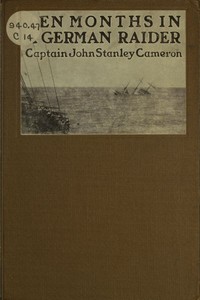
The catalog record for Ten months in a German raider — Themes and Context provides practical reading context through 32,491 words, 2 hr 22 min estimated reading time, and 3 detected text sections.
The text analysis averages about 24.5 words per sentence, while the detected sections provide another way to judge how the source is divided.
Project Gutenberg metadata also associates the work with “World War, 1914-1918 -- Personal narratives,” connecting these edition facts with the source record’s subject description.
Explore this collection
These alternatives are selected using recorded categories and estimated reading time.
About 146 minutes
World Events
33,505 recorded words. 4 minutes difference from this book's estimate.
View Gutenberg source #65761About 147 minutes
World Events
33,608 recorded words. 5 minutes difference from this book's estimate.
View Gutenberg source #49122About 137 minutes
World Events
31,314 recorded words. 5 minutes difference from this book's estimate.
View Gutenberg source #51523Search stored excerpts and compare books → Choose by your preferences →
Choices use stored catalog measurements. Estimates vary with reading speed. A shared category is a catalog label, not a claim that two books have the same argument or literary quality.
Search reads excerpt text stored with this catalog and links to its associated Gutenberg record. The connection is stored in the site database; this tool does not recheck that every excerpt is word-for-word identical to that external record. Excerpt search does not cover every chapter and does not verify historical publication dates.
Catalog snapshot checked: 2026-09-25. Coverage: 91 public books, 91 available source excerpts.
Read the complete public-domain text at its original source.
Read on Project GutenbergCaptain John Stanley Cameron’s account, set down by editor Cyril Brown from the captain’s own words, opens with a blunt contrast: he sailed from San Francisco expecting a two-month voyage to Australia, but ended ten months later in Denmark, having been a prisoner on the German raider Wolf. Brown states he avoided giving the story a “literary finish,” aiming to preserve what he calls a “bully sea yarn.” The result is a narrative that moves between the technical details of ship seizures and the peculiar social dynamics aboard a raider, often with a dry, understated humor—as when Cameron notes that the mermaids must have had “some” bargain sale after thousands of tons of silk goods were sunk.
The editorial hand of Cyril Brown is light but decisive. In his introduction, Brown describes Cameron as a “canny graduate of the ‘before the mast’ school” and says he set down the story “much as it came from his own lips.” The resulting prose is colloquial and direct, with short, declarative sentences and occasional slang. For example, Cameron refers to the German crew as “deep-sea vultures” and describes a chaotic boat launch where a fouled davit fall broke, dropping the boat into the water. The language stays close to spoken rhythms, using phrases like “Sure enough” and “It always seemed uncanny to me.” This oral quality gives the account an immediacy that a more polished memoir might lack, but it also means the narrative sometimes jumps between events without transition.
The pacing of the narrative varies markedly. Early sections describing the capture of the Beluga and the transfer of prisoners are detailed and measured, with Cameron noting the routine of life under guard. But when the raider attacks the Japanese steamer Hitachi Maru, the tempo quickens. Cameron shifts to a moment-by-moment account: the passenger who was reading in bed, the panic of the Japanese crew, the capsized boat, the fouled davit fall. The description of the sinking itself is compressed—a list of cargo values and the disposal of silk kimonos—before the narrative slows again to the tedium of coaling at the Maldives. These abrupt changes in tempo mirror the unpredictable nature of life on a raider, where long periods of waiting are punctuated by sudden violence.
Three motifs recur throughout the excerpts: the precise cataloging of cargo, the constant need for coal, and the ambiguous status of prisoners. Cameron notes the value of the Hitachi Maru’s cargo—“over a million and a half pounds sterling, chiefly copper, tin, rubber, thousands of tons of silk, tea and hides”—and observes that the Germans seemed able to capture a ship with exactly the cargo they needed. The logistics of coaling are a persistent concern: the Wolf and its prize tie up alongside to transfer coal, and the commander hopes to find a vessel with enough coal to reach Germany. Prisoners, meanwhile, are neither fully crew nor passengers; they send a written petition to the commander, but Cameron notes that none took stock in “landing talk.” These details build a picture of a floating world governed by material necessity and the threat of violence.
Readers should attend to the tension between Cameron’s plainspoken delivery and the extraordinary events he describes. The editor’s decision to preserve the captain’s oral style means that the narrative sometimes leaves gaps—what did the prisoners eat during the ten months? How were they guarded?—but it also gives the account a credibility that a more polished version might lack. For those interested in the texture of life aboard a raider, the book offers a rare, unvarnished perspective from a man who was both a prisoner and a professional sailor.
That rainy afternoon, Cameron’s calm accounting of capture aboard the Wolf stayed with me—how men adapted to the absurdity of their floating prison. It made me wonder about other sudden displacements. Later, almost by accident, I picked up Impressions and Experiences of a French Trooper, 1914-1915 — Context and Discussion. Same war, different cage: a soldier’s own bewildered patience. One voice barely faded before the other began.
Capture what you thought, learned, and would like to remember.