About 76 minutes
The Bombardment of Reims — Background and Themes
World Events
17,277 recorded words. 16 minutes difference from this book's estimate.
View Gutenberg source #49649
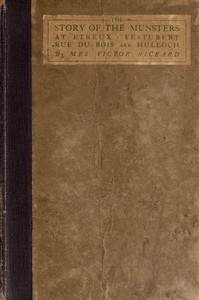
For The Story of the Munsters at Etreux, Festubert, Rue du Bois and Hulloch — Story, Setting & Ideas, the stored edition analysis reports 21,087 words, 1 hr 32 min estimated reading time, and 3 detected text sections.
The text analysis averages about 23.1 words per sentence, while the detected sections provide another way to judge how the source is divided.
Project Gutenberg metadata also associates the work with “World War, 1914-1918 -- Regimental histories -- Great Britain,” connecting these edition facts with the source record’s subject description.
Explore this collection
These alternatives are selected using recorded categories and estimated reading time.
About 76 minutes
World Events
17,277 recorded words. 16 minutes difference from this book's estimate.
View Gutenberg source #49649About 69 minutes
World Events
15,864 recorded words. 23 minutes difference from this book's estimate.
View Gutenberg source #44599About 119 minutes
World Events
27,153 recorded words. 27 minutes difference from this book's estimate.
View Gutenberg source #57453Search stored excerpts and compare books → Choose by your preferences →
Choices use stored catalog measurements. Estimates vary with reading speed. A shared category is a catalog label, not a claim that two books have the same argument or literary quality.
Search reads excerpt text stored with this catalog and links to its associated Gutenberg record. The connection is stored in the site database; this tool does not recheck that every excerpt is word-for-word identical to that external record. Excerpt search does not cover every chapter and does not verify historical publication dates.
Catalog snapshot checked: 2026-09-25. Coverage: 91 public books, 91 available source excerpts.
Read the complete public-domain text at its original source.
Read on Project GutenbergMrs. Victor Rickard's account of the Royal Munster Fusiliers at Etreux, Festubert, Rue du Bois, and Hulloch is built from a distinctive blend of official reports, personal letters, and her own narrative threading. The excerpts reveal a work that shifts between the dispassionate language of a staff officer's summary—'B Company was detailed as right flank guard'—and the raw immediacy of a witness describing men who 'sprang up with a cheer, fixed bayonets and charged.' This editorial note examines how the author's voice and pacing shape the reader's experience of these four battles, drawing on specific textual evidence from the available passages.
The most extended excerpt from the Etreux action reads like a transcribed after-action report: precise times ('At 2.30 p.m. the withdrawal recommenced'), unit designations ('D Company as left flank guard'), and tactical details ('gaps having to be hacked in the hedges'). Rickard does not rewrite this material into a novelistic scene; she preserves its clipped, factual tone. The effect is a narrative that feels authoritative but also emotionally restrained. When casualties are noted—'cost only six or eight wounded'—the understatement is striking. The author seems to trust the facts themselves to carry weight, a choice that gives the early passages a deliberate, almost bureaucratic pace.
Midway through the Etreux account, the rhythm changes abruptly. The sentence 'Before they could do this a heavy fire from rifle and Maxim guns was opened on us from East and South' marks a pivot. Rickard shifts from measured withdrawal to a cascade of events: a shell strikes the guns, horses are hit, and 'a raking rifle fire took us in flank.' The syntax becomes shorter, more paratactic: 'The enemy’s fire was intense... the whole party was put out of action.' The final charge is rendered in a series of rapid, declarative clauses—'The men sprang up with a cheer, fixed bayonets and charged'—that mimic the accelerating violence. This change in pace is not merely stylistic; it mirrors the soldiers' loss of control as the battle turns against them.
Rickard's own voice is almost entirely submerged in the excerpts. She does not use first-person pronouns or overt commentary; the narrative is relayed through a third-person omniscient that seems to channel multiple sources—the commanding officer's perspective, the gunners' actions, the enemy's position. The dedication and preface, however, reveal a personal stake: the book is 'a little tribute' to her husband and his comrades. This tension between intimate motive and impersonal execution shapes the reader's experience. The author's restraint may reflect the conventions of regimental history, but it also creates a peculiar distance: we see men die—'Lieutenant Phayre fell, shot through the heart'—without the narrator's grief intruding. The voice remains that of a compiler, not a mourner.
Readers approaching this text should attend to the shifts in tempo and the deliberate flatness of the prose. Rickard's method—letting official language stand beside moments of intense action—creates a documentary feel that is both a strength and a limitation. The excerpts do not reveal how the later engagements (Festubert, Rue du Bois, Hulloch) are handled, but the pattern established in the Etreux account suggests a work that values accuracy over atmosphere. For those interested in the texture of World War I regimental histories, this book offers a case study in how a writer can balance the demands of tribute and record.
Years after first reading Mrs. Rickard’s account, I still recall its patient, almost weary documentation of mud and waiting. That same unhurried, unflinching voice lives in Kelly of the Foreign Legion: Letters of Légionnaire Russell A. Kelly — A Closer Reading, a quieter testament to how men endure, not by flourish, but by small daily notations. They sit well together on my shelf, two old friends who share a solemn hush.
Use these questions to collect your thoughts before moving on.