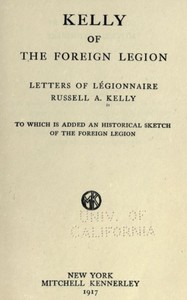
Russell A. Kelly was twenty-one when he volunteered for the French Foreign Legion and began writing letters home to his parents in New York. Those letters, many published in the New York Evening Sun, form the core of this volume. The editor, James Edward Kelly, states that they are retained "in exactly their original form except for the omission of strictly personal matters." The result is a record that preserves the immediacy of a young American's experience—from enlistment in Bordeaux to training at the Dépôt de Lyon and service in the first-line trenches. A prefatory note explains that Kelly was reported missing after the engagement around Souchez on June 16, 1915, and that his name was carried on the list of missing pending a search of German internment camps.
A Voice That Resists Glossing
The editor's decision to leave the letters "in exactly their original form" is crucial. Kelly's prose is direct, often wry, and occasionally profane. In one excerpt he writes, "I certainly do feel fine and enjoy the life, but there is no question about it, war is an asinine thing." The phrasing is colloquial and unpolished, and the editor has not smoothed it into a more literary register. This choice gives the reader access to Kelly's unmediated reactions—his irritation at wet clothes, his sardonic wish for "those new patented trench digging machines," and his frank assessment of his comrades. The letters were written under conditions that allowed little time for reflection, and the text bears the marks of that pressure: short paragraphs, abrupt shifts, and a tone that moves quickly from observation to complaint to dark humor.
The Social World of the Squad
Kelly devotes considerable attention to the men around him, and his descriptions are precise enough to suggest a writer who is both observer and participant. In a letter from the Arras secteur, he catalogues the members of his escouade: a corporal he thinks is "Arab-French," two long-serving Légionnaires—one with "a huge beard" who reminds him of a gnome—two Belgians he calls "unimportant," and two Italians who "remind me of brigands." He notes the alliances and tensions: the old-timers share their sorrows and their "joy" (bought by the canteen), while the Italians kick and cuff a younger Italian. When the corporal slugs a small Légionnaire, Kelly's friend Weeks intervenes, and the fight escalates. These vignettes are not merely color; they show how the Legion's mix of nationalities and personalities created a volatile social order that Kelly had to navigate.
The Physical Texture of Trench Life
Kelly's letters are full of sensory details that convey the discomfort and monotony of trench warfare. He describes lying in three inches of water from his shoulders to his feet, praying for daylight, and then drying out "pretty well" during the day. He complains of digging "about one thousand miles of trenches" and notes that the constant repair work has created "an elaborate system of underground streets." The physical environment is never abstract: a cow shed with ground "as hard as a rock and as cold" serves as a billet; a forced march through fog leaves the men fatigued. These details accumulate to create a picture of war as a series of bodily trials—wet, cold, exhausted—rather than a narrative of heroism. Kelly's tone is matter-of-fact, which makes the discomfort feel more immediate than any dramatic description could.
The Unfinished Record and Its Editorial Frame
The volume's structure is shaped by the abrupt end of Kelly's correspondence. The last communication is a military post card mailed June 15, 1915. The editor then appends a chapter titled "Epilogue" that reports what is known of Kelly's fate: he was officially recorded as "missing" after the engagement at Souchez, with the added statement that his name would be carried on the list until a search could be made in German internment camps. The editor also includes a historical sketch of the Foreign Legion, which occupies the final chapter. This framing turns the letters into a document of uncertainty. Readers encounter the text knowing that the writer's voice will stop without resolution. The editorial apparatus does not attempt to supply closure; it simply records the official status and the efforts made to locate him.
Because the letters are presented with minimal editorial intervention, readers should pay attention to what Kelly chooses to describe and what he leaves out. He is more interested in the behavior of his squadmates and the physical discomforts of trench life than in the strategic situation or the larger course of the war. The editor's preface and epilogue provide essential context, but the letters themselves are best read as a personal document—one that captures a specific voice at a specific moment, without the benefit of hindsight or revision.
Rain was ticking the window that afternoon I finished Kelly’s letters, how he griped about mud yet never quite quit. That odd endurance lingered, and I found myself wondering what peace actually costs. So I pulled down A Revision of the Treaty Being a Sequel to The Economic Consequence of the Peace — Themes and Context, and the trench’s quiet absurdity suddenly felt like an argument about borders. One book simply handed me the next.