About 69 minutes
Beyond the Marne: Quincy, Huiry, Voisins before and during the battle — Context and Discussion
World Events
15,864 recorded words. 6 minutes difference from this book's estimate.
View Gutenberg source #44599
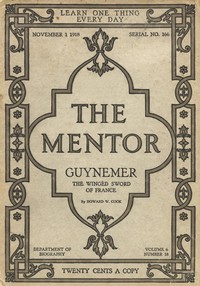
The source record for The Mentor: Guynemer, The Wingèd Sword of France, Vol. 6, Num. 18, Serial No. 166, November 1, 1918 — Key Ideas to Explore measures this digital text at 14,319 words, 1 hr 3 min estimated reading time, and 7 detected text sections.
The text analysis averages about 19.7 words per sentence, while the detected sections provide another way to judge how the source is divided.
Project Gutenberg metadata also associates the work with “World War, 1914-1918 -- Aerial operations,” connecting these edition facts with the source record’s subject description.
Explore this collection
These alternatives are selected using recorded categories and estimated reading time.
About 69 minutes
World Events
15,864 recorded words. 6 minutes difference from this book's estimate.
View Gutenberg source #44599About 76 minutes
World Events
17,277 recorded words. 13 minutes difference from this book's estimate.
View Gutenberg source #49649About 92 minutes
World Events
21,087 recorded words. 29 minutes difference from this book's estimate.
View Gutenberg source #45625Search stored excerpts and compare books → Choose by your preferences →
Choices use stored catalog measurements. Estimates vary with reading speed. A shared category is a catalog label, not a claim that two books have the same argument or literary quality.
Search reads excerpt text stored with this catalog and links to its associated Gutenberg record. The connection is stored in the site database; this tool does not recheck that every excerpt is word-for-word identical to that external record. Excerpt search does not cover every chapter and does not verify historical publication dates.
Catalog snapshot checked: 2026-09-25. Coverage: 91 public books, 91 available source excerpts.
Read the complete public-domain text at its original source.
Read on Project GutenbergHoward W. Cook's 1918 biography of Georges Guynemer, published in The Mentor series while the war still raged, presents a striking paradox: the French ace is described by Commandant Brocard as 'a powerful idea in a frail body,' a phrase that echoes throughout the text. The narrative oscillates between near-mythic elevation—Guynemer as 'the Wingèd Sword of France'—and the gritty, technical details of aerial combat at close range. Cook draws heavily on Guynemer's own notebook entries, which reveal a pilot who coolly analyzes his mistakes, such as opening fire at 100 meters instead of waiting for point-blank range. This editorial note explores three tensions visible in the excerpts: the contrast between the hero's fragile physique and his aggressive tactics, the self-critical precision of his combat reports, and the way the text frames his deeds for a home-front audience.
Brocard's observation that 'the idea would slay the container' sets up a central contrast. Guynemer is repeatedly shown as physically vulnerable: his garments are 'drilled with holes,' his clothing 'taking on the appearance of a sieve.' Yet his combat method relies on extreme proximity—firing at 15 or 20 meters, maneuvering into the enemy's 'dead angle of fire.' The excerpts describe him diving after a falling adversary, continuing to fire, and diagnosing 'the shock of death' in a foe's aircraft. This is not a distant, clinical war but a personal, tactile one. The text emphasizes that Guynemer 'seldom returned from a flight without a wound,' linking his bodily frailty directly to his willingness to accept damage in order to close with the enemy.
Guynemer's own voice, preserved in his notebook, is strikingly analytical. After an early engagement where he exhausted his cartridges at 100 meters, he rebukes himself: 'I had made a mistake just now... I should have waited.' He then revises his method, deciding that attacking 'almost point-blank' is better, 'more risky, but everything lies in maneuvering.' The excerpts show him thinking through tactics mid-flight, even as he closes on a second enemy. This self-critical habit extends to his assessment of enemy behavior: he notes that compelling a Boche to fight is difficult 'not that the latter lacks courage, but rather that he prefers not to run the risk.' The text thus presents Guynemer not as a reckless daredevil but as a calculating craftsman who treats each engagement as a problem to be solved.
Published in November 1918, the biography is explicitly framed as inspirational. Brocard writes that French children 'vibrated with all his emotions' and that Guynemer 'will remain to them the living model hero.' The text includes a photograph of Guynemer receiving the Rosette of the Legion of Honor, and his fifth citation declares him 'a hunting pilot with audacity and energy for any adventure.' Yet the excerpts also reveal a tension: the same pilot who coolly calculates firing distances is described as bearing 'a part of our dreams, of our faith in success.' The narrative serves a dual purpose—documenting technical achievements while constructing a national symbol. Readers in 1918 would have encountered this as both a factual account and a piece of wartime morale-building, a blend that the modern reader must navigate carefully.
Readers approaching this 1918 text should attend to its dual nature: it is at once a detailed combat memoir and a piece of wartime propaganda. The excerpts offer a rare glimpse into a pilot's tactical thinking, but they also show how that thinking was packaged for a public hungry for heroes. Comparing Guynemer's own notebook entries with the framing commentary by Brocard and Cook reveals the gap between the pilot's self-critical voice and the legend being constructed around him.
That old 1918 piece on Guynemer still sits with me—how a body so fragile held such precision, and how his own notes turned into quiet self-judgment. It reminded me of reading Boche and Bolshevik Experiences of an Englishman in the German Army and in Russian Prisons — Background and Themes, where survival also becomes a kind of private record, unglamorous and true. Both feel less like war stories, more like someone whispering what they couldn’t say out loud.
Save your reaction, strongest insight, and memorable passage.