About 147 minutes
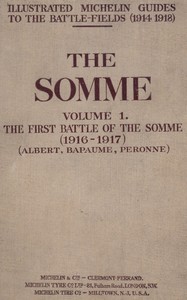
The Somme, Volume 1. The First Battle of the Somme (1916-1917) (Albert, Bapaume, Péronne) — Inside the Classic
World Events
33,608 recorded words. 1 minutes difference from this book's estimate.
View Gutenberg source #49122

Before opening A Merchant Fleet at War — Background and Themes, the edition data offers a quick orientation: 33,505 words, 2 hr 26 min estimated reading time, and 12 detected text sections.
The text analysis averages about 28.6 words per sentence, while the detected sections provide another way to judge how the source is divided.
Project Gutenberg metadata also associates the work with “World War, 1914-1918 -- Naval operations,” connecting these edition facts with the source record’s subject description.
Explore this collection
These alternatives are selected using recorded categories and estimated reading time.
About 147 minutes
World Events
33,608 recorded words. 1 minutes difference from this book's estimate.
View Gutenberg source #49122About 147 minutes
World Events
33,764 recorded words. 1 minutes difference from this book's estimate.
View Gutenberg source #56299About 142 minutes
World Events
32,491 recorded words. 4 minutes difference from this book's estimate.
View Gutenberg source #52656Search stored excerpts and compare books → Choose by your preferences →
Choices use stored catalog measurements. Estimates vary with reading speed. A shared category is a catalog label, not a claim that two books have the same argument or literary quality.
Search reads excerpt text stored with this catalog and links to its associated Gutenberg record. The connection is stored in the site database; this tool does not recheck that every excerpt is word-for-word identical to that external record. Excerpt search does not cover every chapter and does not verify historical publication dates.
Catalog snapshot checked: 2026-09-25. Coverage: 91 public books, 91 available source excerpts.
Read the complete public-domain text at its original source.
Read on Project GutenbergArchibald Hurd opens his account of the Cunard fleet's wartime service with a frank admission: British seamen had little time or inclination to record their activities during the war. The preface stresses that many incidents could not be reported in detail at the time, and that many of the men who contributed to this volume have since died. Hurd acknowledges his reliance on captains, officers, engineers, and pursers who supplied incidents, written records, and photographs—many of them taken under enemy fire, soaked with seawater, or recovered at the last moment. The result is a work that foregrounds the difficulty of its own making.
Hurd's preface does more than thank contributors. It establishes the book's documentary character and its limits. He notes that the illustrations were made from photographs of 'all sorts and shapes, taken by all kinds of cameras,' often under 'dull and forbidding skies.' The value of these images, he insists, lies not in their perfection but in the knowledge that they were taken 'on active service.' This emphasis on authenticity over polish runs through the excerpts. The preface also introduces a recurring tension: the men whose exploits are recorded 'dislike publicity,' and their modesty 'disarms the inquisitor.' Hurd positions himself as a reluctant chronicler, pressing stories from those who would rather not tell them.
The longest excerpt describes the sinking of the Lusitania from the perspective of a survivor. The narrative is precise about physical details: the torpedo struck, the forepart was enveloped in steam, and the forward tackle jammed, causing a boat to spill its occupants. The writer notes that 'absolute coolness prevailed' on deck, with only 'a few isolated cases' of hysteria among women. The description of the ship's final plunge is stark: 'the monster took a sudden plunge,' and the stern rose 'high out of the water' before a 'thunderous roar' and disappearance. The wireless installation crashed into the sea, striking the narrator's arm. The account is notable for its restraint—no grand pronouncements, only the sequence of events and the writer's own fear as he swam away.
Hurd repeatedly draws attention to the photographs that accompany the text. In the preface, he explains that many pictures were 'snapped under dull and forbidding skies' and some were 'secured in the very presence of the enemy.' A few were 'soaked with sea water' or 'recovered from destruction at the last moment.' This framing turns the illustrations into artifacts of risk, not mere decoration. The reader is invited to see each image as a document of the photographer's proximity to danger. The book includes a map 'shewing incidents,' and the captions often note the circumstances of the photograph—for instance, the 'Aquitania' leading transports, or the 'Franconia' passing through the Suez Canal. The visual record reinforces the text's claim to firsthand witness.
Throughout the excerpts, Hurd returns to the difficulty of compiling the book. The preface states that 'the very nature of many of the incidents precluded the preparation of detailed reports at the time.' He also notes that many officers and men have since died, making their accounts irreplaceable. The Lusitania narrative itself is a survivor's testimony, written after the fact, and it includes gaps—the narrator does not know whether a second torpedo struck, and he relies on a stoker's report for the cause of the steam cloud. Hurd does not smooth over these uncertainties. Instead, he presents the book as a collection of imperfect but vital records, shaped by the chaos of war and the reticence of the men who lived through it.
Readers should approach A Merchant Fleet at War as a compilation of fragmentary testimonies, not a unified history. Hurd's preface and the Lusitania excerpt both demonstrate how the book's authority rests on the willingness of merchant sailors to share their experiences—and on the accidents that preserved their photographs and memories. The work rewards attention to its framing devices: the preface, the captions, and the occasional admission of ignorance. These elements reveal the conditions under which the book was made, and they give the narrative its particular weight.
I kept thinking about those merchant sailors, their quiet resourcefulness under fire, long after I closed the book. It made me wonder about the other quiet voices from that same war, the ones we rarely hear. That’s why From Convent to Conflict; Or, A Nun's Account of the Invasion of Belgium — Context and Discussion stayed with me too—a different perspective, yes, but the same ache of ordinary people caught in something vast and terrible.
Your answers remain private and are stored only in this browser.