About 163 minutes
Ypres to Verdun A Collection of Photographs of the War areas in France & Flanders — Inside the Classic
World Events
37,417 recorded words. 4 minutes difference from this book's estimate.
View Gutenberg source #57144
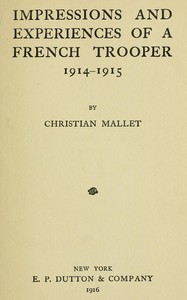
The catalog record for Impressions and Experiences of a French Trooper, 1914-1915 — Context and Discussion provides practical reading context through 36,459 words, 2 hr 39 min estimated reading time, and 4 detected text sections.
The text analysis averages about 20.7 words per sentence, while the detected sections provide another way to judge how the source is divided.
Project Gutenberg metadata also associates the work with “World War, 1914-1918 -- Campaigns -- Belgium,” connecting these edition facts with the source record’s subject description.
Explore this collection
These alternatives are selected using recorded categories and estimated reading time.
About 163 minutes
World Events
37,417 recorded words. 4 minutes difference from this book's estimate.
View Gutenberg source #57144About 147 minutes
World Events
33,608 recorded words. 12 minutes difference from this book's estimate.
View Gutenberg source #49122About 147 minutes
World Events
33,764 recorded words. 12 minutes difference from this book's estimate.
View Gutenberg source #56299Search stored excerpts and compare books → Choose by your preferences →
Choices use stored catalog measurements. Estimates vary with reading speed. A shared category is a catalog label, not a claim that two books have the same argument or literary quality.
Search reads excerpt text stored with this catalog and links to its associated Gutenberg record. The connection is stored in the site database; this tool does not recheck that every excerpt is word-for-word identical to that external record. Excerpt search does not cover every chapter and does not verify historical publication dates.
Catalog snapshot checked: 2026-09-25. Coverage: 91 public books, 91 available source excerpts.
Read the complete public-domain text at its original source.
Read on Project GutenbergChristian Mallet's memoir of the 22nd Dragoons opens not with grand strategy but with the immediate, physical texture of mobilization: broken window-panes, a burning building, horses groped for in the dark. The excerpts show a writer who records the small, exhausting rhythms of active service—nights without sleep, a storm that wets men to the skin, a heap of coal used as a bed—alongside moments of stark violence. The book's structure follows a chronological route from Rheims into Belgium, through retreat and counter-attack, but its real subject is the gap between official maps and the soldier's sensory experience. Mallet's voice is precise, often understated, and attentive to the landscape's indifference: 'All Nature was en fête' as his squadron prepared for a dismounted action against two or three German divisions.
The excerpts reproduce dated entries—'9th October,' '10th October'—that read less like polished narrative than a field notebook. Mallet notes distances covered ('twenty kilomètres'), the condition of his horse ('slightly wounded in the foreleg'), and the constant disruption of orders: no sooner had men fed their horses than they were ordered back to the place they had left. This granular detail gives the memoir a documentary quality. The reader can track the regiment's movements from Chocques to Estaires to La Gorgue, but the diary form also foregrounds what planning documents omit: the exhaustion of men who 'have had nothing to eat' and the casual heroism of sharing a woollen handkerchief against the cold. The catalog subject 'World War, 1914-1918 -- Campaigns -- Belgium' is thus rendered not as a series of battles but as a succession of billets, bridges, and trenches, each recorded with the same flat tone.
Mallet's Belgium is a country in flight. The excerpts describe 'the whole population in flight, leaving houses open to the streets,' and later a village 'evacuated only three days ago' with houses 'partly fallen in and still smoking.' Yet the memoir also records moments of fragile continuity: an old teacher who assembles twenty schoolboys to sing the Marseillaise as the dragoons pass. The contrast between the triumphal entry of August and the march 'past ruins and over rubbish heaps' in October is explicit. Mallet does not moralize; he simply notes the 'touching manifestations of confidence and enthusiasm' that arise from the thresholds of ruined homes. These passages complicate the catalog's 'Personal narratives, French' label by showing that the narrator's experience is inseparable from the civilian world he moves through—a world that is both devastated and, in small ways, still performing its rituals.
The book's frontispiece depicts a night charge of the 22nd Dragoons near Compiègne, and the excerpts include the captain's warning that the task would be a 'stiff one' and that it was a question of 'sticking it out to the last drop of our blood.' Yet the actual charge is described in the frontispiece caption, not in the diary entries reproduced here. This gap between the set-piece action and the daily grind is characteristic of the excerpts: the reader learns more about the hours spent in a trench without greatcoats than about the cavalry attack itself. The memoir's value lies in this imbalance. Mallet records the physical cost—men 'benumbed, exhausted, but gay as ever'—and the strange juxtaposition of a 'fresh strong wind' with the order to prepare for a dismounted action. The charge is a known event; the memoir shows what it cost to get there.
Mallet's prose is notable for what it does not say. He records that Lieutenant Niel was 'knocked over into the ditch and wounded' without commentary. He notes that he and Magrin 'huddle up one against the other' for warmth. The tone is matter-of-fact, even when describing a shell that 'burst just opposite with a terrible row.' This restraint is a deliberate rhetorical choice: the reader infers the terror from the precision of the detail. The memoir also includes moments of dark humor—'parked like sheep' in a grocer's shop—that leaven the catalogue of discomfort. The voice is that of a trooper who is both participant and observer, and the excerpts suggest that the book's power lies in its accumulation of such small, exact observations rather than in any overarching argument about the war.
Readers approaching this memoir should set aside expectations of a continuous narrative or a panoramic view of the Western Front. Mallet's account is best read as a series of vignettes, each anchored to a specific date and place. The index and chapter titles offer a map, but the real geography is sensory: the feel of a coal heap at night, the sound of the Marseillaise from a smoking village, the weight of a cartridge case carried across ploughed fields. The book rewards attention to these details, which together form a record of endurance that is both personal and representative of the French cavalry's experience in the first year of the war.
That French dragoon’s quiet notes—mud, fatigue, the odd shared joke—stay with you longer than the battles do. Reading his spare honesty made me think of another war’s diary, the one from Gallipoli, where the same tired humor flickers under worse skies. Both leave you feeling you’ve merely walked beside them, not through their “glory.” Trooper Bluegum at the Dardanelles Descriptive Narratives of the More Desperate Engagements on the Gallipoli Peninsula — Reading Companion holds that same fragile, human warmth.
Answer a few questions and save a private reflection on this device.