About 159 minutes
Impressions and Experiences of a French Trooper, 1914-1915 — Context and Discussion
World Events
36,459 recorded words. 4 minutes difference from this book's estimate.
View Gutenberg source #62629
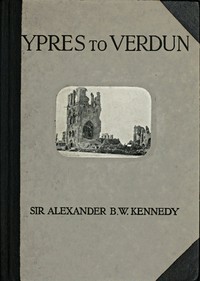
The source record for Ypres to Verdun A Collection of Photographs of the War areas in France & Flanders — Inside the Classic measures this digital text at 37,417 words, 2 hr 43 min estimated reading time, and 17 detected text sections.
The text analysis averages about 24.8 words per sentence, while the detected sections provide another way to judge how the source is divided.
Project Gutenberg metadata also associates the work with “World War, 1914-1918 -- Campaigns -- Western Front,” connecting these edition facts with the source record’s subject description.
Explore this collection
These alternatives are selected using recorded categories and estimated reading time.
About 159 minutes
World Events
36,459 recorded words. 4 minutes difference from this book's estimate.
View Gutenberg source #62629About 147 minutes
World Events
33,608 recorded words. 16 minutes difference from this book's estimate.
View Gutenberg source #49122About 147 minutes
World Events
33,764 recorded words. 16 minutes difference from this book's estimate.
View Gutenberg source #56299Search stored excerpts and compare books → Choose by your preferences →
Choices use stored catalog measurements. Estimates vary with reading speed. A shared category is a catalog label, not a claim that two books have the same argument or literary quality.
Search reads excerpt text stored with this catalog and links to its associated Gutenberg record. The connection is stored in the site database; this tool does not recheck that every excerpt is word-for-word identical to that external record. Excerpt search does not cover every chapter and does not verify historical publication dates.
Catalog snapshot checked: 2026-09-25. Coverage: 91 public books, 91 available source excerpts.
Read the complete public-domain text at its original source.
Read on Project GutenbergSir Alexander Kennedy's preface immediately establishes the book's origin: an official visit to the front in October 1918, when the chief difficulty was 'to keep up with the retreating Germans.' He describes the landscape as a 'featureless waste of shell-holes' where villages were only recognisable by painted notices reading 'This is Givenchy' or 'This was Givenchy.' The photographs, taken in September 1919 with Lieutenant-Colonel Douglas Gill, aim to provide a permanent record of devastation that Kennedy felt 'the average man' at home could not imagine from correspondents' descriptions alone.
Kennedy's professional background shapes his observations. He notes that roads, fields, and orchards had become 'a featureless waste of shell-holes, often already covered with rank herbage altogether disguising their original nature.' His captions frequently quantify destruction: in Rheims, nearly as many houses were destroyed as the 13,000 said to have been burnt in the Great Fire of London. He also records curious details, such as trees in a felled avenue that had 'reassert their life,' producing 'gigantic bushes growing out of the stumps.' These precise, almost clinical descriptions contrast with the emotional weight of the scenes.
In the section on the Somme, Kennedy recounts a 'wonderful dress rehearsal' for crossing the Hindenburg Line at the St. Quentin Canal on 27 September 1918. Rafts, collapsible boats, life-lines, and 3,000 life-belts were tested near the Château of Brie. He notes that the crossing succeeded without 'hesitation nor failure,' and links this to the capture of the 'absolutely impregnable' section by the Terriers. The photographs of this area—such as Plate 65 showing the crossing point—are paired with tactical explanations, giving the reader a sense of how the terrain influenced military operations.
Kennedy's captions for individual plates are terse but evocative. Plate LI shows a stretch of the Somme road where the avenue of trees is 'not so entirely destroyed as in many other places.' Plate LIII notes that Mametz 'has practically disappeared,' with the foreground covering 'what had once been cottages.' Plate LIV describes Trones Wood as 'shell-holes, chalk trenches and bare trunks,' adding that the trunks are 'much more numerous than in the Ypres Salient.' These repeated phrases—'practically disappeared,' 'all that remain'—build a cumulative picture of total ruin, while the occasional mention of a cross or a returning owner (Plate LVI) hints at human presence.
Kennedy is candid about what his camera could not capture. He explains that photography was forbidden in Army Areas during the war, and his 1919 visit came after the fighting had ceased. The images show aftermath, not action. He also notes phenomena he 'seldom saw elsewhere and cannot explain,' such as the re-sprouting tree stumps. These admissions remind the reader that the book is a partial record—one engineer's attempt to document a landscape that was already changing, overgrown with 'rank weeds' that disguised the scars. The preface's epigraph from Maurois—'Quand pensez-vous que la guerre sera finie?'—underscores the uncertainty that pervades even this retrospective view.
Readers should approach Ypres to Verdun as a document of a specific moment: the immediate postwar period when the physical traces of war were still raw but beginning to be reclaimed by nature. Kennedy's dual role as engineer and photographer means the text balances technical precision with a layman's wonder. The captions reward careful reading, as they often contain the only narrative thread linking the plates. For those interested in the material culture of the Western Front, this book offers a unique, ground-level perspective that complements official histories.
I keep thinking about how that engineer walked those fields in 1919, photographing what remained—not rubble, exactly, but a quiet kind of absence. It felt like watching someone hold their breath. That same hush lives in The Bombardment of Reims — Background and Themes, where a cathedral’s scars speak more softly than any intact spire ever could.
Answer a few questions and save a private reflection on this device.