About 135 minutes
The Square Jaw — Story, Setting & Ideas
World Events
30,821 recorded words. 0 minutes difference from this book's estimate.
View Gutenberg source #48592
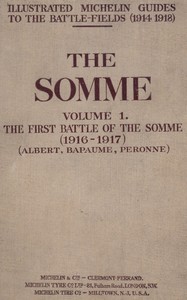
Before opening The Somme, Volume 2. The Second Battle of the Somme (1918) (Amiens, Montdidier, Compiègne) — Reading Companion, the edition data offers a quick orientation: 30,891 words, 2 hr 15 min estimated reading time, and 17 detected text sections.
The text analysis averages about 16.1 words per sentence, while the detected sections provide another way to judge how the source is divided.
Project Gutenberg metadata also associates the work with “World War, 1914-1918 -- Battlefields -- Guidebooks,” connecting these edition facts with the source record’s subject description.
Explore this collection
These alternatives are selected using recorded categories and estimated reading time.
About 135 minutes
World Events
30,821 recorded words. 0 minutes difference from this book's estimate.
View Gutenberg source #48592About 133 minutes
World Events
30,411 recorded words. 2 minutes difference from this book's estimate.
View Gutenberg source #51222About 137 minutes
World Events
31,314 recorded words. 2 minutes difference from this book's estimate.
View Gutenberg source #51523Search stored excerpts and compare books → Choose by your preferences →
Choices use stored catalog measurements. Estimates vary with reading speed. A shared category is a catalog label, not a claim that two books have the same argument or literary quality.
Search reads excerpt text stored with this catalog and links to its associated Gutenberg record. The connection is stored in the site database; this tool does not recheck that every excerpt is word-for-word identical to that external record. Excerpt search does not cover every chapter and does not verify historical publication dates.
Catalog snapshot checked: 2026-09-25. Coverage: 91 public books, 91 available source excerpts.
Read the complete public-domain text at its original source.
Read on Project GutenbergThis Michelin guidebook, published shortly after the war, treats the 1918 Second Battle of the Somme as both a historical event and a tourist destination. Its opening pages list hotels in Amiens and Compiègne, then shift abruptly to the front line of March 21, 1918. The guide’s dual purpose—to inform visitors and commemorate—shapes its unusual voice: precise about distances and road numbers, yet capable of noting that a church’s roof was rebuilt after a fire in 1768. The narrative pace alternates between dense tactical accounts and unhurried architectural descriptions, as when a detailed passage on Caix church’s 16th-century pillars follows a report of German machine-gun nests being destroyed.
The guide merges two genres: a chronological battle account and a driving tour. Paragraphs describing French counter-attacks on April 25–28, 1918—complete with unit numbers and shell calibers—are followed by directions like “At Hill 104, take on the left the road to Roye (G.C. 203).” This juxtaposition creates a distinctive rhythm. The reader is asked to imagine standing where Moroccan Division troops cleared Hangard Wood, then to notice saps and battery positions along the road. The guide assumes a motorist with a Michelin map (sheet no. 6) who wants both historical context and practical navigation. The pace slows when the text lingers on a church’s “delicately carved vine-foliage” or a “large holy-water basin of unusual shape,” only to accelerate again with a terse note that German occupation stripped the zinc and lead-work.
The guide’s most striking feature is its forensic attention to damaged buildings. The description of Caix church runs for several paragraphs, noting the 15th–16th century square belfry, the “accolade-shaped archivolts,” and the rose window. Then, without transition, it records the losses: “All the zinc and lead-work was stripped off and taken away by the Germans during the occupation of 1918. The wooden leaves of the entrance door were removed. The building suffered severely from the bombardments.” This catalog of destruction is delivered in the same flat, factual tone as the architectural praise. The effect is cumulative: the guide makes the reader see what was there, then what was taken. The voice remains neutral, but the juxtaposition of beauty and ruin carries its own weight.
The narrative voice moves between grand tactical sweeps and minute observations. One sentence describes “two of their divisions being thrown into disorder”; the next notes a “door in the western front forms a low overhanging arch.” This constant zooming in and out is the guide’s defining structural trait. The pace changes abruptly: a dense paragraph on the Moroccan Division’s advance, supported by British tanks, gives way to a leisurely account of a church’s “16th century pillars, without capitals, in the nave, are decorated with finely carved canopies.” The guide never explains why these shifts occur; it simply presents the battlefield as a place where military history and architectural heritage coexist. For the reader, this means moving between the urgency of combat and the stillness of a mutilated carving.
Readers should approach this guide as a layered document: part history, part travelogue, part memorial. The Michelin company’s commercial interests—advertising tyres and maps—sit alongside a commemorative list of employees who died in the war. The guide’s value lies not in its completeness as a battle history but in its peculiar juxtapositions. Pay attention to what the text chooses to describe in detail and what it passes over quickly; those choices reveal the guide’s assumptions about what a visitor should see and remember.
These guides feel like old friends. The Michelin volume’s quiet toll of ruined towns, their stones catalogued like patient wounds, always reminds me of the wearier, more human ledger kept in With the Scottish Regiments at the Front — Context and Discussion. Both whisper of what remains after the guns fall silent, trusting the reader to hear the hush between the lines.
Create a short personal record of your experience with this book.