About 544 minutes
The Irish Guards in the Great War, Volume 1 (of 2) — Background and Themes
World Events
125,085 recorded words. 14 minutes difference from this book's estimate.
View Gutenberg source #64638
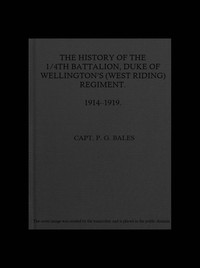
History of the 1/4th Battalion Duke of Wellington's (West Riding) Regiment, 1914-1919. — Background and Themes can be approached with a clearer sense of reading commitment from its source measurements: 121,728 words, 8 hr 50 min estimated reading time, and 31 detected text sections.
The text analysis averages about 16.4 words per sentence, while the detected sections provide another way to judge how the source is divided.
Project Gutenberg metadata also associates the work with “World War, 1914-1918 -- Regimental histories -- Great Britain,” connecting these edition facts with the source record’s subject description.
Explore this collection
These alternatives are selected using recorded categories and estimated reading time.
About 544 minutes
World Events
125,085 recorded words. 14 minutes difference from this book's estimate.
View Gutenberg source #64638About 546 minutes
World Events
125,476 recorded words. 16 minutes difference from this book's estimate.
View Gutenberg source #49875About 585 minutes
World Events
134,513 recorded words. 55 minutes difference from this book's estimate.
View Gutenberg source #66251Search stored excerpts and compare books → Choose by your preferences →
Choices use stored catalog measurements. Estimates vary with reading speed. A shared category is a catalog label, not a claim that two books have the same argument or literary quality.
Search reads excerpt text stored with this catalog and links to its associated Gutenberg record. The connection is stored in the site database; this tool does not recheck that every excerpt is word-for-word identical to that external record. Excerpt search does not cover every chapter and does not verify historical publication dates.
Catalog snapshot checked: 2026-09-25. Coverage: 91 public books, 91 available source excerpts.
Read the complete public-domain text at its original source.
Read on Project GutenbergCaptain P. G. Bales, who served as adjutant and kept the battalion's war diary for over two years, draws on official documents and personal recollections to construct this history. The preface reveals a collaborative process: proofs were reviewed by senior officers, and the author acknowledges specific contributors, including Lieutenant-Colonel A. L. Mowat, who handled the business side. This editorial note examines how the opening, middle, and later excerpts guide a first reading, highlighting the author's method and the text's evolving focus.
The preface establishes Bales's dual role as participant and historian. He states the history is 'based mainly on the official documents in the Battalion’s possession,' supplemented by personal recollections. The war diary, which he himself maintained, forms the backbone. Notably, Bales submitted proofs to at least two senior officers per chapter, incorporating their criticisms. This collaborative vetting suggests a deliberate effort to ensure accuracy, though it also implies a degree of institutional oversight. The list of named contributors—including Brigadier-General Sugden and Lieutenant-Colonel Atkinson—indicates the battalion's hierarchy was closely involved. For a first reader, this preface signals that the narrative will be detailed and officially sanctioned, but also shaped by the perspectives of those who led the unit.
A middle excerpt describes the battlefield in stark, visceral terms: 'every inch of ground had been torn up by shell fire,' roads had 'almost disappeared,' and woods were reduced to 'broken and distorted tree-stumps.' The author invokes Dante to convey the hellish landscape. This passage is notable for its sensory detail—'dead bodies of men and animals, derelict tanks and guns'—and for emphasizing the mud, which 'converted the whole area into a quagmire.' The description is not merely atmospheric; it explains tactical difficulties: transport could only move on newly-made tracks, and men were 'bogged well above the knees.' For a reader, this section grounds the battalion's experience in a specific, grueling environment, illustrating how terrain and weather shaped operations.
Another excerpt recounts the battalion's sudden move to support the attack on Passchendaele Ridge. The order came at night, and the relief was conducted in 'very dark and wet' conditions along a single line of grids. The author notes that 'not a man of the Battalion had any clear idea where he was, or where the front line lay.' This admission of confusion is striking, as it contrasts with the orderly tone of the preface. The battalion's accommodation consisted of 'low-lying, very wet, and extremely uncomfortable pill-boxes' or shell-holes. The narrative shifts from strategic overview to the immediate, disorienting reality of troops arriving in an unfamiliar sector. This passage demonstrates Bales's willingness to include moments of uncertainty, offering a ground-level view of operations.
The excerpts suggest a chronological structure, moving from the battalion's formation in 1914 through to 1919. The preface indicates the war diary was well preserved 'particularly since the beginning of 1916,' implying that earlier periods may rely more on memory. The later excerpt, describing the Passchendaele battle in October 1917, shows the narrative's density: it includes specific place names (Red Rose Camp, Pommern Castle, Berlin Wood), unit designations (147th Infantry Brigade, 2nd New Zealand Infantry Brigade), and tactical details (barrage depth, zero hour). This granularity is typical of regimental histories. A first reader should expect a mix of operational orders, personal anecdotes, and descriptive passages, with the author occasionally stepping back to offer broader reflections, as with the Dante allusion.
Bales's history rewards readers who attend to its prefatory material and the interplay between official records and personal testimony. The excerpts reveal a work that is both meticulous and human, balancing the demands of accuracy with the chaos of war. For those approaching the text, noting the date and location of each action, as well as the sources cited, will illuminate how the battalion's story was constructed from the ground up.
That rainy afternoon, I was deep in Bales’s meticulous account of the 1/4th Battalion—the mud, the grim arithmetic of names—when a footnote about a Belgian convent made me pause. The war’s other side felt suddenly human. I set him aside for From Convent to Conflict; Or, A Nun's Account of the Invasion of Belgium — Context and Discussion, and the rain kept falling, and the quiet felt different.
Your answers remain private and are stored only in this browser.