About 546 minutes
The History of the 2/6th (Rifle) Battalion, "the King's" (Liverpool Regiment) 1914-1919 — Background and Themes
World Events
125,476 recorded words. 39 minutes difference from this book's estimate.
View Gutenberg source #49875
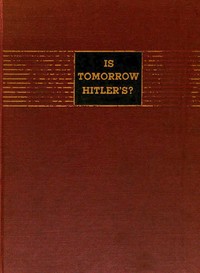
This digital edition of Is Tomorrow Hitler's? 200 Questions on the Battle of Mankind — Reading Companion is described by source-level measurements including 134,513 words, 9 hr 45 min estimated reading time, and 22 detected text sections.
The text analysis averages about 22.6 words per sentence, while the detected sections provide another way to judge how the source is divided.
Project Gutenberg metadata also associates the work with “Europe -- Politics and government -- 1918-1945,” connecting these edition facts with the source record’s subject description.
Explore this collection
These alternatives are selected using recorded categories and estimated reading time.
About 546 minutes
World Events
125,476 recorded words. 39 minutes difference from this book's estimate.
View Gutenberg source #49875About 544 minutes
World Events
125,085 recorded words. 41 minutes difference from this book's estimate.
View Gutenberg source #64638About 530 minutes
World Events
121,728 recorded words. 55 minutes difference from this book's estimate.
View Gutenberg source #67633Search stored excerpts and compare books → Choose by your preferences →
Choices use stored catalog measurements. Estimates vary with reading speed. A shared category is a catalog label, not a claim that two books have the same argument or literary quality.
Search reads excerpt text stored with this catalog and links to its associated Gutenberg record. The connection is stored in the site database; this tool does not recheck that every excerpt is word-for-word identical to that external record. Excerpt search does not cover every chapter and does not verify historical publication dates.
Catalog snapshot checked: 2026-09-25. Coverage: 91 public books, 91 available source excerpts.
Read the complete public-domain text at its original source.
Read on Project GutenbergKnickerbocker's book is structured as a series of 200 questions, each answered in a conversational, first-person style. The table of contents alone reveals the scope: from 'Have you ever met Hitler?' to 'What should we do with Hitler after he is defeated?' The questions are grouped by country—Germany, Russia, England—and later by broader themes. This format invites the reader to dip in and out, treating each answer as a self-contained briefing.
The excerpts show that Knickerbocker often begins his answers with direct, unadorned statements, then builds a case with specific examples. For instance, when asked about America's post-war economic prospects, he lists four reasons, grounding each in observable conditions like England's bombed cities or the Lend-Lease program. The tone is urgent but measured, aiming to inform rather than inflame.
The book's organizing principle—200 questions—is not a gimmick but a deliberate method for addressing a bewildering array of wartime issues. Knickerbocker uses the Q&A to simulate a press conference or a one-on-one briefing. The questions are blunt: 'Is Hitler personally brave?' 'Can Stalin be trusted?' 'What place will Churchill have in history?' Each answer runs from a paragraph to several pages, allowing the author to pivot from psychology to economics to military strategy within a single chapter.
This structure also reveals what American readers in 1941 were most anxious about. The questions on Germany dominate the first chapter, reflecting the immediate threat. The Russia chapter, written after the German invasion, grapples with whether to trust Stalin. The England chapter focuses on Churchill's leadership and the durability of British resistance. By grouping questions by nation, Knickerbocker creates a comparative framework: the reader can contrast Hitler's Germany, Stalin's Russia, and Churchill's England side by side.
The excerpts show a writer who does not hide his views. When asked about America's post-war economic advantage, he admits, 'This sounds almost as though I thought the war would be a blessing to America,' then immediately qualifies: 'Actually I do not think the war will be a blessing, except as it unifies us.' This self-correction is characteristic—Knickerbocker presents an optimistic scenario only to temper it with realism.
His language is concrete. He refers to 'our monstrous hoard of gold' and predicts that private plane production 'could go into six figures and then into seven.' He uses analogies from everyday life, such as comparing post-war aviation to the automobile boom after Ford. The tone is that of a seasoned correspondent who has seen the war up close and is now translating that experience for a domestic audience. He does not hesitate to criticize: the French leadership under Vichy is dismissed as lacking 'initiative and courage.'
Throughout the excerpts, Knickerbocker returns to two linked ideas: the United States must enter the war quickly, and it will emerge in a uniquely strong position. He argues that America's physical safety depends on 'the British Isles, our foremost fortress' continuing to resist. The economic argument is detailed: no war damage, easy conversion to peacetime production, and a world desperate for American goods.
Yet he warns against complacency. The phrase 'if we enter the war in time' appears repeatedly, suggesting that delay could squander this advantage. He also cautions against an 'over-cheerful view of ourselves,' reminding readers that other nations will be 'maimed by bombardment' and 'fiscally bankrupt.' This tension—between confidence and caution—gives the book a persuasive edge. Knickerbocker is not merely reporting; he is advocating for a specific policy: immediate, full American involvement.
The provided excerpts cover only the opening and a later section on post-war economics. The bulk of the book—the detailed chapters on Germany, Russia, and England—is not sampled. Readers will not find here Knickerbocker's assessment of Hitler's personality or his analysis of the Soviet terror. The table of contents hints at these discussions, but the actual answers remain unknown.
This means the book's full argument about the nature of Nazism, the reliability of Stalin, and the prospects for a post-war order can only be inferred. The excerpts do show that Knickerbocker is willing to tackle uncomfortable topics: he asks 'Are we running a risk if we support the Russians?' and 'Under what circumstances would Stalin make a separate peace?' These questions suggest a nuanced, skeptical perspective that goes beyond simple propaganda. A complete reading would reveal how he balances support for the Allied cause with critical analysis of its leaders.
Knickerbocker's book is best approached as a series of briefings, each answer a self-contained argument. Readers may wish to start with the questions that most concern them—whether about Hitler's psychology, Russia's resilience, or America's post-war role—and then explore the rest. The Q&A format rewards browsing, but the cumulative effect is a comprehensive, if opinionated, survey of the global conflict as it stood in 1941. The book's value lies not in predicting the future but in capturing the anxieties and debates of its moment.
There’s something almost haunting about Knickerbocker’s 1941 questions—each one a snapshot of a world holding its breath. I find myself thinking of Churchill’s own uncertainty then, the way he weighed every catastrophe. For quiet hours beside that volume, The World Crisis, Volume 1 (of 6) — Edition Insights feels like an old friend’s diary, full of the same tremble before the storm. It stays with me.
Your answers remain private and are stored only in this browser.