About 264 minutes
Fighting Germany's Spies — Key Ideas to Explore
World Events
60,617 recorded words. 0 minutes difference from this book's estimate.
View Gutenberg source #57307
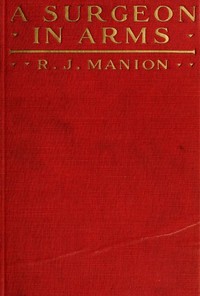
The source record for A Surgeon in Arms — Background and Themes measures this digital text at 60,673 words, 4 hr 24 min estimated reading time, and 5 detected text sections.
The text analysis averages about 24.2 words per sentence, while the detected sections provide another way to judge how the source is divided.
Project Gutenberg metadata also associates the work with “World War, 1914-1918 -- Personal narratives, Canadian,” connecting these edition facts with the source record’s subject description.
Explore this collection
These alternatives are selected using recorded categories and estimated reading time.
About 264 minutes
World Events
60,617 recorded words. 0 minutes difference from this book's estimate.
View Gutenberg source #57307About 261 minutes
World Events
60,018 recorded words. 3 minutes difference from this book's estimate.
View Gutenberg source #46037About 278 minutes
World Events
63,867 recorded words. 14 minutes difference from this book's estimate.
View Gutenberg source #63332Search stored excerpts and compare books → Choose by your preferences →
Choices use stored catalog measurements. Estimates vary with reading speed. A shared category is a catalog label, not a claim that two books have the same argument or literary quality.
Search reads excerpt text stored with this catalog and links to its associated Gutenberg record. The connection is stored in the site database; this tool does not recheck that every excerpt is word-for-word identical to that external record. Excerpt search does not cover every chapter and does not verify historical publication dates.
Catalog snapshot checked: 2026-09-25. Coverage: 91 public books, 91 available source excerpts.
Read the complete public-domain text at its original source.
Read on Project GutenbergR.J. Manion opens A Surgeon in Arms not with a grand thesis but with a specific scene: sitting in a dugout near Fresnoy while heavy shelling forces soldiers to crowd into his shelter. The darkness and the casual chat between two men from the same English hometown—Faversham, Kent—immediately establish the memoir's reliance on concrete detail and natural dialogue. Manion lets the soldiers' exchange reveal their identities: one has been in Canada seventeen years, the other only three, and their banter about accents and origins feels unscripted. This opening signals that the author values the texture of lived experience over abstract commentary.
Manion frequently reproduces the speech of the men around him, and these passages are among the most distinctive in the book. The exchange between Reggie Roberts and the soldier from Faversham is not a set piece but a fragment of overheard conversation, complete with dropped h's and colloquial exclamations like "Well, I'm blowed!" Such dialogue does more than add color; it documents the social mix within Canadian battalions—English-born men who had emigrated, French Canadians, and others. Manion does not comment on the linguistic variety; he simply records it. Later, the Irish soldier Kelly appears with his own pithy sayings, such as "A man that's not afeard o' thim shells has more courage than sinse." These voices give the narrative a polyphonic quality, reminding the reader that the author is one observer among many.
Chapter V, titled "The Language of the Line," signals Manion's interest in the specialized slang that developed among soldiers. He does not provide a glossary, but his own prose absorbs terms like "barrage," "shell hole," and "dugout" without explanation, assuming a reader already familiar with the war's lexicon. More striking is his use of understatement: a shell crater "into which you could drop a small house" is described with matter-of-fact precision. Manion's diction is generally plain—he prefers "courage" to "valor," "fear" to "trepidation"—but he occasionally reaches for a clinical term, as when he describes shell shock as a "malady" that leaves the nervous system unable to "resiliency rebound." This blend of soldier's vernacular and medical terminology reflects his dual role as both participant and physician.
Rather than a continuous narrative from enlistment to discharge, Manion organizes his memoir by topic. Chapters bear titles like "Life in the Trenches," "Over the Top," "Gassed!," "Dugouts," and "The Sick Parade." This structure allows him to examine facets of war experience in depth, but it also means the reader must infer the timeline from passing references—such as the Battle of Vimy Ridge in April 1917, which receives its own chapter. The foreword explains that most of the book was written before the United States entered the war, which accounts for the absence of American soldiers in earlier chapters. Manion's arrangement prioritizes thematic coherence over strict chronology, making the book feel like a series of essays or dispatches rather than a diary.
Manion's medical training shapes his descriptions of injury and trauma. He distinguishes between cowardice and shell shock with diagnostic care: the truly shell-shocked man "trembles violently," has a "terrified air," and may "cry out or weep like a child." These are not moral failings but symptoms of a nervous system pushed past its limits. Yet Manion also acknowledges the gray area—men who hide in shell holes during an advance and later claim to have been stunned. He writes that they "are more to be pitied than blamed," but notes that the moral law against cowardice overrides the physical instinct for self-preservation. This tension between empathy and judgment runs through the book, and Manion never fully resolves it. His observations remain those of a frontline doctor who must treat the wounded and also judge who is fit for duty.
Readers approaching A Surgeon in Arms should expect a memoir that moves between the intimate and the analytical. Manion does not provide a sweeping history of the war or a detailed account of his own career; instead, he offers a series of sharply observed vignettes, each anchored in a specific place or theme. The book rewards attention to its minor characters—the chatty soldiers, the stoic wounded, the occasional shirker—and to the author's own voice, which is by turns wry, clinical, and quietly moved. It is a document of its moment, written while the war was still ongoing, and its immediacy is both a strength and a limitation.
I finished R.J. Manion’s memoir the other night, and it stayed with me—not the gas or the mud, but how quietly he writes about fear. There’s something in that same plain-spoken honesty I found later in The Way of the Air: A Description of Modern Aviation — A Reader’s Guide, like both men simply watched the sky and told the truth about what it cost them.
Your answers remain private and are stored only in this browser.