About 181 minutes
The Way of the Air: A Description of Modern Aviation — A Reader’s Guide
World Events
41,435 recorded words. 2 minutes difference from this book's estimate.
View Gutenberg source #51581
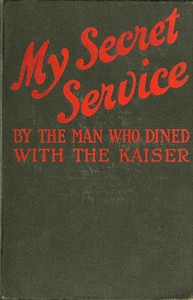
The catalog record for My Secret Service: Vienna, Sophia, Constantinople, Nish, Belgrade, Asia Minor, etc. — Themes and Context provides practical reading context through 41,095 words, 2 hr 59 min estimated reading time, and 4 detected text sections.
The text analysis averages about 23.0 words per sentence, while the detected sections provide another way to judge how the source is divided.
Project Gutenberg metadata also associates the work with “World War, 1914-1918 -- Personal narratives,” connecting these edition facts with the source record’s subject description.
Explore this collection
These alternatives are selected using recorded categories and estimated reading time.
About 181 minutes
World Events
41,435 recorded words. 2 minutes difference from this book's estimate.
View Gutenberg source #51581About 163 minutes
World Events
37,417 recorded words. 16 minutes difference from this book's estimate.
View Gutenberg source #57144About 196 minutes
World Events
45,006 recorded words. 17 minutes difference from this book's estimate.
View Gutenberg source #64455Search stored excerpts and compare books → Choose by your preferences →
Choices use stored catalog measurements. Estimates vary with reading speed. A shared category is a catalog label, not a claim that two books have the same argument or literary quality.
Search reads excerpt text stored with this catalog and links to its associated Gutenberg record. The connection is stored in the site database; this tool does not recheck that every excerpt is word-for-word identical to that external record. Excerpt search does not cover every chapter and does not verify historical publication dates.
Catalog snapshot checked: 2026-09-25. Coverage: 91 public books, 91 available source excerpts.
Read the complete public-domain text at its original source.
Read on Project GutenbergThe anonymous author, styling himself "The Man Who Dined With the Kaiser," opens his narrative with a direct address to the reader, immediately establishing a tone of personal testimony. His account, based on three journeys through enemy and neutral territory in 1915, is structured as a series of dispatches from Vienna, Sofia, Constantinople, and Asia Minor. The prose is brisk and observational, often shifting from broad strategic commentary to specific, verifiable details—such as the toll on the Galata Bridge or the aftermath of a powder factory explosion. This blend of intelligence-gathering and travelogue gives the work a distinctive, reportorial voice that prioritizes concrete evidence over dramatic embellishment.
The narrator’s tone is consistently urgent, driven by a desire to alert British readers to what he perceives as dangerous complacency. He writes, "I view with alarm this dangerous and apathetic frame of mind," referring to public disbelief about German-Turkish plans against Egypt. His sentences are often declarative and short, mimicking the rhythm of a field report. He avoids self-aggrandizement, instead grounding his authority in specific observations: the training of 4,000 German soldiers to ride camels at Hagenbeck’s Menagerie, or the condition of Turkish troops leaving for the Caucasus. The voice is that of a neutral observer—he claims to be "a neutral with no axe to grind"—yet the narrative is clearly shaped by Allied sympathies. This tension between claimed neutrality and evident partisanship gives the prose an intriguing, if occasionally contradictory, quality.
The narrative moves rapidly from city to city, mirroring the author’s own travel pace. Each chapter focuses on a new location, with the tempo varying between dense strategic analysis and anecdotal interludes. For instance, the description of Vienna is subdued and statistical, dwelling on casualties and shortages, while the Constantinople sections shift to more vivid, almost ethnographic details—such as the Turkish newspapers’ underreporting of an explosion that killed two thousand. The author often pauses to test official claims, as when he verifies the bridge toll exemption for Germans by speaking German himself. These moments of direct investigation break the flow of general observation, adding a layer of procedural realism. The overall structure feels less like a polished memoir and more like a series of intelligence briefs, with the author’s personal experiences serving as evidence for broader conclusions about German war aims.
Certain details recur with pointed effect. The author repeatedly notes the financial strain on the Ottoman Empire, exemplified by the Turks’ inability to pay for a repaired bridge, resulting in Germans crossing free. He also emphasizes the German effort to train camelry at a Hamburg zoo—a detail that underscores the thoroughness he attributes to German planning. Another recurring motif is the discrepancy between official reports and on-the-ground reality, as seen in the powder factory explosion. These details are not merely colorful; they serve as evidence for the author’s central argument that the German-Turkish alliance posed a serious, underestimated threat. The cumulative effect is to build a case through accumulation of specific, often verifiable observations, rather than through rhetorical flourish. The reader is left with the impression of a narrator who trusts concrete facts over abstract argument.
Readers should approach this text as a primary source document rather than a conventional memoir. The author’s anonymity and claimed neutrality invite scrutiny of his motives and biases, while the episodic structure rewards attention to the specific, often mundane details he chooses to record. The narrative’s value lies less in its overarching argument than in the granular observations of wartime conditions in the Ottoman Empire and the Balkans. For those interested in the intelligence-gathering methods of the era, the work offers a rare, if partial, window into how one agent operated and what he deemed worth reporting.
Reading that anonymous agent’s quiet observations on the crumbling Ottoman corridors, I found myself thinking of another kind of flight entirely—young Guynemer’s solitary ascents, chronicled in The Mentor: Guynemer, The Wingèd Sword of France, Vol. 6, Num. 18, Serial No. 166, November 1, 1918 — Key Ideas to Explore. Both men moved through worlds already half-lost, recording shadows before the light went out entirely.
Save your reaction, strongest insight, and memorable passage.