About 181 minutes
The Way of the Air: A Description of Modern Aviation — A Reader’s Guide
World Events
41,435 recorded words. 15 minutes difference from this book's estimate.
View Gutenberg source #51581
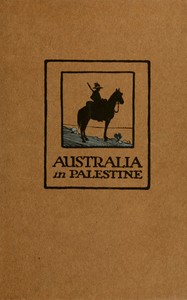
Before opening Australia in Palestine — Themes and Context, the edition data offers a quick orientation: 45,006 words, 3 hr 16 min estimated reading time, and 40 detected text sections.
The text analysis averages about 21.2 words per sentence, while the detected sections provide another way to judge how the source is divided.
Project Gutenberg metadata also associates the work with “World War, 1914-1918 -- Campaigns -- Palestine,” connecting these edition facts with the source record’s subject description.
Explore this collection
These alternatives are selected using recorded categories and estimated reading time.
About 181 minutes
World Events
41,435 recorded words. 15 minutes difference from this book's estimate.
View Gutenberg source #51581About 211 minutes
World Events
48,370 recorded words. 15 minutes difference from this book's estimate.
View Gutenberg source #54057About 179 minutes
World Events
41,095 recorded words. 17 minutes difference from this book's estimate.
View Gutenberg source #67951Search stored excerpts and compare books → Choose by your preferences →
Choices use stored catalog measurements. Estimates vary with reading speed. A shared category is a catalog label, not a claim that two books have the same argument or literary quality.
Search reads excerpt text stored with this catalog and links to its associated Gutenberg record. The connection is stored in the site database; this tool does not recheck that every excerpt is word-for-word identical to that external record. Excerpt search does not cover every chapter and does not verify historical publication dates.
Catalog snapshot checked: 2026-09-25. Coverage: 91 public books, 91 available source excerpts.
Read the complete public-domain text at its original source.
Read on Project GutenbergThis volume was assembled by soldiers in the field under active service conditions, as the editors note, and its contents—prose, verse, sketches, and photographs—were contributed almost entirely by members of the Australian Imperial Force. Rather than a comprehensive history, it offers a mosaic of immediate impressions: a night march, a mail day, a horse's account of campaigns from Beersheba to Jaffa. The book's dedication 'to the memory of fallen comrades' sets a somber tone, yet the pieces range from grim humor to elegy.
The editors explicitly state that Australia in Palestine 'is in no sense intended as a complete picture of the Australians’ part in the Great Campaign.' Instead, it is 'merely a Soldiers’ Book, produced almost entirely by soldiers in the field.' This framing is essential: the reader encounters not a staff officer's overview but a collection of fragments—some humorous, some stark—that reflect the conditions of active service. The inclusion of verse alongside reports, and the presence of an art editor (David Barker), underscores the collaborative, makeshift nature of the project. Profits were designated for an A.I.F. fund, reinforcing its character as a unit effort rather than a commercial venture.
One of the most distinctive pieces is 'A Waler’s Story,' narrated by a horse named Baldy. This device allows for a sideways view of the campaign: the horse comments on his rider Bill's absences ('I’d be a stableman for a month if I could get those three days in Cairo again'), the scarcity of rations, and the death of a fellow horse from thirst. The horse's perspective highlights the physical toll—'we stood in the heat and sweated from sunrise to sunset; during the night we shivered with the cold'—and the arbitrary nature of survival when a shell lands 'right underneath a horse next to me and sent him West.' The horse's desire to die 'a soldier' blurs the line between animal and combatant.
The collection balances grim details with a dry, laconic humor. In 'A Waler’s Story,' the horse notes that mules 'were a hungry lot of cannibals' that ate the horses' rugs and even gnawed the hair off a sick pal. The editors' thanks to contributors include a sergeant who 'took charge of the business arrangements,' suggesting a blend of military discipline and amateur production. Poems like 'One Too Many' and 'The Little Bint of Wady Hanein' indicate that the soldiers' experiences included not only combat but also the mundane and the absurd. This mixture prevents the book from becoming a mere chronicle of suffering; it is also a record of camaraderie and resilience.
Readers should approach this anthology as a primary source rather than a polished narrative. The variety of voices—from official reports to light verse—means that the tone shifts abruptly. Pay attention to the gaps: what is left unsaid about strategy or politics, and what is emphasized in the soldiers' own words. The book's structure, with its many short pieces, invites browsing; the illustrations and photographs (not included in this text-only edition) were integral to the original publication.
Some evenings I open that soldier-made anthology from Palestine and think of the horses, patient under the dust. Then my hand wanders to the quieter companion, Ypres to Verdun A Collection of Photographs of the War areas in France & Flanders — Inside the Classic, whose grey fields mirror that same weary stillness. Both hold a war’s breath, and I hold them gently.
Your answers remain private and are stored only in this browser.