About 443 minutes
The Grenadier Guards in the Great War of 1914-1918, Vol. 1 of 3 — Edition Insights
World Events
101,788 recorded words. 7 minutes difference from this book's estimate.
View Gutenberg source #60677
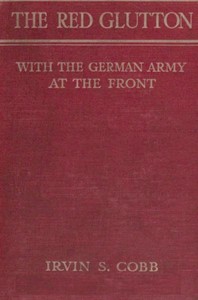
For The Red Glutton: With the German Army at the Front — Reading Companion, the stored edition analysis reports 100,195 words, 7 hr 16 min estimated reading time, and 9 detected text sections.
The text analysis averages about 25.1 words per sentence, while the detected sections provide another way to judge how the source is divided.
Project Gutenberg metadata also associates the work with “World War, 1914-1918 -- Personal narratives,” connecting these edition facts with the source record’s subject description.
Explore this collection
These alternatives are selected using recorded categories and estimated reading time.
About 443 minutes
World Events
101,788 recorded words. 7 minutes difference from this book's estimate.
View Gutenberg source #60677About 419 minutes
World Events
96,251 recorded words. 17 minutes difference from this book's estimate.
View Gutenberg source #50379About 469 minutes
World Events
107,807 recorded words. 33 minutes difference from this book's estimate.
View Gutenberg source #54441Search stored excerpts and compare books → Choose by your preferences →
Choices use stored catalog measurements. Estimates vary with reading speed. A shared category is a catalog label, not a claim that two books have the same argument or literary quality.
Search reads excerpt text stored with this catalog and links to its associated Gutenberg record. The connection is stored in the site database; this tool does not recheck that every excerpt is word-for-word identical to that external record. Excerpt search does not cover every chapter and does not verify historical publication dates.
Catalog snapshot checked: 2026-09-25. Coverage: 91 public books, 91 available source excerpts.
Read the complete public-domain text at its original source.
Read on Project GutenbergIrvin S. Cobb's The Red Glutton opens not with a declaration of war but with a ruined village—Montignies St. Christophe, struck by a passing German column. Cobb, an American journalist, frames the narrative through a series of such scenes, moving from village to battlefield to general's headquarters. The book's structure mirrors the march itself: a relentless forward motion punctuated by halts where the observer takes stock of devastation. Cobb repeatedly contrasts the pastoral landscape with the scars of war—'scuffed and scored minutely as though a myriad swine had rooted there for mast'—and notes how quickly nature begins to cover the damage. This tension between the temporary and the permanent, the human and the mechanical, runs through the entire account.
The narrative is built on a rhythm of pursuit and pause. Cobb and his companions are always trying to 'catch up with the German rear guard,' but the Germans 'moved faster than we did, even though they fought as they went.' This chase structure gives the book a forward thrust, yet each stopping point—a village, a battlefield, a general's mess—becomes a set piece for observation. At Montignies St. Christophe, the stillness of the dead town contrasts with the recent passage of the column. Later, on the plateau near Laon, the landscape appears 'peaceful enough' despite the recent battle, with 'new grass springing up in the hoof tracks.' Cobb uses these moments of stillness to measure the war's aftermath, noting how quickly the land recovers while the human cost remains invisible.
The title The Red Glutton signals a central metaphor: war as an insatiable eater. Cobb reinforces this through repeated images of consumption. The German army 'hooping [Belgium] in with tight bands of steel' like a cooper around a cask suggests a mechanical devouring of territory. At General von Zwehl's headquarters, the staff lunch on 'soup and sausages, with a rare and precious Belgian melon'—a moment of normalcy that feels almost grotesque given the context. The battlefield itself is described as 'scuffed and scored' as if by rooting swine. Cobb also notes the 'littering of weather-beaten French knapsacks and mired uniform coats,' remnants of the army's passage. These details accumulate to portray war as a process of ingestion and waste, consuming men and materiel alike.
Cobb frequently shifts between close-up observation and a broader, almost cartographic view. In the opening chapter, he recalls passing through the region a year earlier by train, seeing villages 'like beads on a cord.' Now, on foot, the same landscape is transformed by war. Later, General von Zwehl uses a 'little riding whip' to point out the 'theater' of his recent battle, turning the terrain into a map of tactics. Cobb himself moves between these scales: he describes the 'gouges of wheels and feet' at the roadside, then steps back to note that 'the Germans were already across the line, beating down the sod of France.' This oscillation between the intimate and the strategic gives the reader a sense of war as both a personal encounter and a vast, impersonal machine.
Cobb is careful to define his own role. He is not a combatant but a witness, traveling with the German army as a journalist. This position allows him to move between scenes—from a ruined village to a general's mess—without fully belonging to either. He notes the 'shabby grandeur' of a Belgian gendarme before the war, but now that same figure is gone. At von Zwehl's headquarters, he relies on an interpreter, 'Von Theobald standing handily by to translate.' Cobb's detachment is both a limitation and a strength: he can report what he sees, but he cannot fully enter the experience of the soldiers. The book's structure, with its episodic scenes and shifting focus, reflects this outsider's perspective—always moving, always observing, never quite settling.
Cobb's account is best read as a series of snapshots rather than a continuous narrative. The movement between scenes—village, battlefield, headquarters—mirrors the journalist's task of assembling fragments into a coherent picture. Pay attention to the recurring images of consumption and repair; they reveal Cobb's underlying argument about war's nature. The book does not offer a single thesis but accumulates details that resist easy moralizing. For readers interested in the texture of war reporting, The Red Glutton provides a valuable record of how one observer tried to make sense of the chaos.
Across my shelves, certain books whisper to one another across the decades. Cobb’s The Red Glutton captures war’s hungry machinery, its appetite for young men. Reading it, I often think of Kelly of the Foreign Legion: Letters of Légionnaire Russell A. Kelly — A Closer Reading, another voice swallowed by that same vast, impersonal hunger. Both men witnessed the consuming maw, and their quiet testimonies rest here, side by side, bearing witness together.
Save your reaction, strongest insight, and memorable passage.