About 436 minutes
The Red Glutton: With the German Army at the Front — Reading Companion
World Events
100,195 recorded words. 7 minutes difference from this book's estimate.
View Gutenberg source #61177
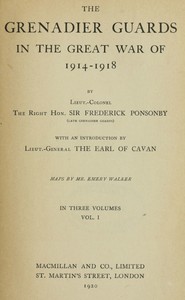
This digital edition of The Grenadier Guards in the Great War of 1914-1918, Vol. 1 of 3 — Edition Insights is described by source-level measurements including 101,788 words, 7 hr 23 min estimated reading time, and 32 detected text sections.
The text analysis averages about 21.1 words per sentence, while the detected sections provide another way to judge how the source is divided.
Project Gutenberg metadata also associates the work with “World War, 1914-1918 -- Regimental histories -- Great Britain,” connecting these edition facts with the source record’s subject description.
Explore this collection
These alternatives are selected using recorded categories and estimated reading time.
About 436 minutes
World Events
100,195 recorded words. 7 minutes difference from this book's estimate.
View Gutenberg source #61177About 419 minutes
World Events
96,251 recorded words. 24 minutes difference from this book's estimate.
View Gutenberg source #50379About 469 minutes
World Events
107,807 recorded words. 26 minutes difference from this book's estimate.
View Gutenberg source #54441Search stored excerpts and compare books → Choose by your preferences →
Choices use stored catalog measurements. Estimates vary with reading speed. A shared category is a catalog label, not a claim that two books have the same argument or literary quality.
Search reads excerpt text stored with this catalog and links to its associated Gutenberg record. The connection is stored in the site database; this tool does not recheck that every excerpt is word-for-word identical to that external record. Excerpt search does not cover every chapter and does not verify historical publication dates.
Catalog snapshot checked: 2026-09-25. Coverage: 91 public books, 91 available source excerpts.
Read the complete public-domain text at its original source.
Read on Project GutenbergThis volume opens with an introduction by Lieutenant-General the Earl of Cavan, who describes the regimental history as the work of an old officer of the Grenadier Guards. Cavan reflects on the balance between responsibility and tradition that a battalion commander must maintain, noting that while modern weapons like gas and high explosives take a heavier toll, it is still 'the solid determination of the man that wins the fight.' The preface, written by the author Frederick Ponsonby, explains that the account is 'substantially, the work of the officers of the Regiment themselves,' drawing on letters, diaries, and material collected at the Regimental Orderly Room.
The preface reveals a distinctive method of authorship: Ponsonby assembled the narrative from firsthand accounts contributed by officers. Letters and diaries 'full of interesting detail' were sent to him, alongside a vast amount of information gathered by Colonel Sir H. Streatfeild at the Regimental Orderly Room. This approach means the text is not a top-down official history but a mosaic of individual perspectives, filtered through a single editor. The result is a record that preserves the voice of the regiment itself, though the excerpts do not show how Ponsonby reconciled conflicting accounts or selected which details to include.
The excerpts from November and December 1914 provide concrete details of life in the line. The battalion endured heavy rain turning to snow, leading to widespread trench foot and frostbite. Goats' skins and white smocks were issued for patrol duty, as 'the dark uniforms showed up so clearly in the snow.' The constant digging of sap-heads by the enemy and continuous shelling are noted, alongside the arrival of drafts of men and officers—listed by name and rank. Casualties are recorded matter-of-factly: Lieutenant E. S. Ward wounded, Captain Rose of the Royal Engineers killed. The text does not dwell on emotion but on the practicalities of relief, reinforcement, and the physical toll of the weather.
On December 1, 1914, King George V visited the division, accompanied by the Prince of Wales, the French President, General Joffre, and Major-General Sir Pertab Singh. A Special Order of the Day from the King is reproduced in full, addressing 'Officers, Non-Commissioned Officers and Men' and praising their 'discipline, pluck, and endurance, inspired by the indomitable regimental spirit.' The order uses formal, inspirational language—'I cannot share in your trials, dangers, and successes, but I can assure you of the proud confidence and gratitude of myself and of your fellow-countrymen'—which contrasts with the terse, administrative tone of the surrounding narrative. This juxtaposition highlights how the regimental history blends official pronouncements with the mundane details of trench life.
Readers should approach this volume as a curated collection of primary sources rather than a synthesized analysis. The catalog subject 'World War, 1914-1918 -- Regimental histories -- Great Britain' accurately describes the work, but the excerpts show that the text is less a narrative history and more a compilation of daily entries, officer lists, and official orders. Those interested in the granular details of battalion administration, casualty reporting, and the physical conditions of trench warfare will find this volume valuable, while those seeking broader strategic analysis will need to look elsewhere.
There’s something almost unbearably tender about those Grenadier letters, officers noting the weather between casualty lists—men keeping order in chaos. It makes me think of the other side of that same war, the civilian one, glimpsed in From Convent to Conflict; Or, A Nun's Account of the Invasion of Belgium — Context and Discussion. Both are just records of people trying to hold onto normalcy while the world dissolves around them. I find that quiet persistence more moving than any grand statement.
Your answers remain private and are stored only in this browser.