About 67 minutes
The Memoirs of a Swine in the Land of Kultur; or, How it Felt to be a Prisoner of War — A Closer Reading
Modern Nations
15,278 recorded words. 9 minutes difference from this book's estimate.
View Gutenberg source #67760
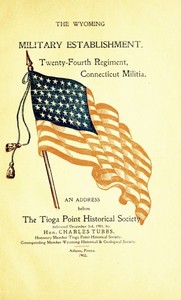
For The Wyoming Military Establishment. A History of the Twenty-fourth Regiment of Connecticut Militia An Address Before the Tioga Point Historical Society, Delivered — Key Ideas to Explore, the stored edition analysis reports 13,308 words, 58 min estimated reading time, and 2 detected text sections.
The text analysis averages about 15.1 words per sentence, while the detected sections provide another way to judge how the source is divided.
Project Gutenberg metadata also associates the work with “United States -- History -- Revolution, 1775-1783,” connecting these edition facts with the source record’s subject description.
Explore this collection
These alternatives are selected using recorded categories and estimated reading time.
About 67 minutes
Modern Nations
15,278 recorded words. 9 minutes difference from this book's estimate.
View Gutenberg source #67760About 73 minutes
Modern Nations
16,729 recorded words. 15 minutes difference from this book's estimate.
View Gutenberg source #48754About 77 minutes
Modern Nations
17,579 recorded words. 19 minutes difference from this book's estimate.
View Gutenberg source #53814Search stored excerpts and compare books → Choose by your preferences →
Choices use stored catalog measurements. Estimates vary with reading speed. A shared category is a catalog label, not a claim that two books have the same argument or literary quality.
Search reads excerpt text stored with this catalog and links to its associated Gutenberg record. The connection is stored in the site database; this tool does not recheck that every excerpt is word-for-word identical to that external record. Excerpt search does not cover every chapter and does not verify historical publication dates.
Catalog snapshot checked: 2026-09-25. Coverage: 91 public books, 91 available source excerpts.
Read the complete public-domain text at its original source.
Read on Project GutenbergCharles Tubbs's address to the Tioga Point Historical Society, delivered in 1901, opens not with the regiment but with a striking analogy: Alsace-Lorraine, a conquered province, is compared to the Wyoming Valley, a Connecticut settlement forcibly annexed by Pennsylvania. This rhetorical move establishes a legal and emotional framework before any military history is recounted. The narrative voice is that of a descendant—Tubbs dedicates the work to his ancestors, members of the Twenty-fourth Regiment—and this personal stake infuses the account with a sense of inherited memory. The address shifts between formal historical argument, drawing on charters and legislative records, and vivid, almost cinematic descriptions of the 1778 battle and its aftermath. The pacing varies markedly: early sections proceed with measured, legalistic exposition, while later passages accelerate into a harrowing account of flight and loss.
The address begins as a territorial dispute, citing King James I's 1620 charter and the Connecticut Colony's grant. Tubbs builds a case that the Wyoming Valley was legally part of Connecticut, using phrases like “an integral part of the State of Connecticut” and listing institutions—town, county, judge, sheriff, representatives. This section is dense with proper nouns and dates, establishing a foundation of legitimacy. Then, abruptly, the tone shifts. The narrative moves to the battle itself, describing the “massed in columns of four” approach of Major John Butler's Rangers and the Seneca chiefs “streaked with paint, adorned with feathers.” The language becomes sensory: “screech of fife,” “roll of drums,” “picturesque barbaric ornaments.” This transition from dry legalism to visceral detail mirrors the regiment's own sudden plunge from administrative existence into violent conflict.
Tubbs explicitly invokes oral tradition: “This scene as it came down to me when a child, from the reported words of a great grandmother who witnessed it, most profoundly impressed my youthful imagination.” This single sentence reveals the address's dual nature—it is both a public historical lecture and a private family story. The grandmother's eyewitness account is not quoted directly, but its emotional residue shapes the narrative. Tubbs does not claim omniscience; he presents the surrender and subsequent flight through a blend of documentary evidence (Articles of Capitulation, muster rolls, pay rolls) and inherited testimony. The phrase “most profoundly impressed my youthful imagination” acknowledges the subjective lens through which this history is filtered. This personal stake gives the account a particular urgency, especially in describing the “hurried, hasty, precipitate flight” of the valley's inhabitants.
The address's pacing is carefully calibrated. After the battle's climax, the narrative slows to detail the terms of surrender and the regiment's dissolution: “The Twenty-fourth regiment was never reorganized. It was overwhelmed on the field of battle; it was surrendered in sections, by the terms of four military conventions.” The repetition of “it was” creates a rhythmic finality. Then, a counterpoint: “On the other hand many of the men considered themselves absolved.” Tubbs lists those who continued fighting—Lieutenant Colonel Zebulon Butler, Captain John Franklin—and points to an “original pay roll” in the building where he speaks. This juxtaposition of defeat and persistence mirrors the historical reality: the regiment ended, but its men did not. The final image of the dead lying unburied for nearly four months, until a detail of thirty men performed “that solemn duty,” closes the narrative on a note of grim, understated dignity.
Tubbs's address is best read as a layered document: a legal brief, a battle narrative, a family memoir, and a commemorative speech. Pay attention to how he weaves together charter language, casualty figures, and personal recollection. The shifts in pace—from measured exposition to rapid, almost breathless description—reflect the regiment's own trajectory from administrative routine to catastrophic violence. The address does not claim to be a complete regimental history; it is a selective, impassioned account shaped by the speaker's ancestry and his audience's expectations. Readers interested in the intersection of local history and personal memory will find this a revealing example of early twentieth-century historical practice.
Reading Tubbs’s careful shift from legal record to the roar of battle, I remembered my grandfather’s voice telling the same story twice—once dry, once trembling. That same ache came back with A Sketch of the 29th Regiment of Connecticut Colored Troops — Background and Themes, where documentation yields to quiet pride. Both feel like holding a letter someone never mailed.
Answer a few questions and save a private reflection on this device.