About 73 minutes
The Dardanelles: Colour Sketches From Gallipoli — A Reader’s Guide
Modern Nations
16,729 recorded words. 4 minutes difference from this book's estimate.
View Gutenberg source #48754
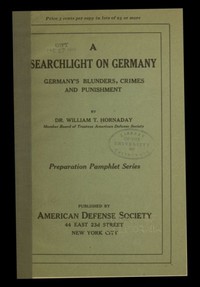
A searchlight on Germany: Germany's Blunders, Crimes and Punishment — Reading Notes can be approached with a clearer sense of reading commitment from its source measurements: 17,579 words, 1 hr 17 min estimated reading time, and 2 detected text sections.
The text analysis averages about 21.8 words per sentence, while the detected sections provide another way to judge how the source is divided.
Project Gutenberg metadata also associates the work with “World War, 1914-1918 -- Causes,” connecting these edition facts with the source record’s subject description.
Explore this collection
These alternatives are selected using recorded categories and estimated reading time.
About 73 minutes
Modern Nations
16,729 recorded words. 4 minutes difference from this book's estimate.
View Gutenberg source #48754About 67 minutes
Modern Nations
15,278 recorded words. 10 minutes difference from this book's estimate.
View Gutenberg source #67760About 88 minutes
Modern Nations
20,097 recorded words. 11 minutes difference from this book's estimate.
View Gutenberg source #62266Search stored excerpts and compare books → Choose by your preferences →
Choices use stored catalog measurements. Estimates vary with reading speed. A shared category is a catalog label, not a claim that two books have the same argument or literary quality.
Search reads excerpt text stored with this catalog and links to its associated Gutenberg record. The connection is stored in the site database; this tool does not recheck that every excerpt is word-for-word identical to that external record. Excerpt search does not cover every chapter and does not verify historical publication dates.
Catalog snapshot checked: 2026-09-25. Coverage: 91 public books, 91 available source excerpts.
Read the complete public-domain text at its original source.
Read on Project GutenbergWilliam T. Hornaday opens A Searchlight on Germany with a blunt warning against what he calls the inevitable 'magnanimity' toward Germany, framing the war as a struggle between freedom and a 'bloody military dragon.' The pamphlet, published by the American Defense Society, is structured as three linked chapters on blunders, crimes, and punishment. Hornaday’s diction is deliberately inflammatory: Germany is a 'rat in a pit,' its leaders 'dunderheads,' and its soldiers 'monsters.' He intersperses moral condemnation with itemized lists, such as a table of submarine attacks and hospital ship sinkings, to lend a documentary air to his accusations. The author’s voice is that of an outraged prosecutor, not a detached historian, and he explicitly aims to prevent Americans from supporting a 'whitewashed peace.'
Hornaday’s language is consistently visceral and dehumanizing. He describes Germany as a 'mortally wounded wolf' and a 'black-hearted murderer of defenseless women, children and old men.' The pamphlet’s opening paragraphs rely on animal imagery and hyperbole to frame the nation as irredeemably savage. This is not a neutral catalog of events but a deliberate effort to shape public emotion. The author also employs sarcasm, as when he writes of German 'men of science' inventing poison gas—the scare quotes around 'men of science' undercutting any respect for German intellectual achievement. Such rhetorical choices reveal Hornaday’s primary aim: to foreclose sympathy by painting Germany as beyond the pale of civilized conduct.
Rather than sustained narrative, Hornaday builds his case through lists and statistics. He provides a dated table of submarine attacks—Falaba, Lusitania, Arabic, Ancona, Persia, Sussex—each with a death toll. He similarly enumerates hospital ships destroyed, including the Portugal with 45 Red Cross nurses lost. The effect is cumulative and impersonal, turning individual tragedies into a ledger of atrocity. One striking entry describes the sinking of the Belgian Prince, where the crew was stripped of life-belts and their boats smashed before the submarine submerged. Hornaday adds a terse editorial: 'A new trick. Look for frequent repetitions.' This blend of data and ominous prediction is characteristic of his method.
A recurring theme is the perversion of German science and scholarship. Hornaday devotes a section to the use of poison gas and liquid fire, calling them 'forms of deviltry forbidden in civilized warfare.' He then recounts an incident in which German forces in South-West Africa poisoned wells with arsenical cattle-dip, citing a written defense by Lieutenant-Colonel Franke. Most damningly, he alleges that German diplomats smuggled cultures of glanders and anthrax into Romania under diplomatic seal, only to have them discovered buried in a consulate garden. Hornaday’s phrasing—'the world owes much to German science'—is turned into a bitter irony. These examples serve to argue that Germany’s intellectual elite actively abetted war crimes.
Hornaday makes no pretense of objectivity. His preface warns that 'a German peace means a German triumph, and the certainty of another war.' The pamphlet is explicitly a tool of the American Defense Society, priced at three cents per copy in bulk, designed for mass distribution. Its structure—three chapters, each building toward a call for harsh punishment—reflects a propagandistic purpose. The author’s authority rests on his role as a board member, not on firsthand knowledge of the events he describes. Readers should recognize that the text is a wartime polemic, not a historical analysis. Its value lies in documenting the rhetorical strategies used to mobilize American opinion against Germany in 1917.
Hornaday’s pamphlet is best read as a primary source for American home-front propaganda during World War I. Its charged language, selective evidence, and urgent tone reveal how organizations like the American Defense Society sought to counter any movement toward a negotiated peace. Readers interested in the construction of wartime enmity will find here a vivid example of how atrocity narratives were assembled and deployed. The text does not attempt balance; it is a prosecution brief, and its power lies in its single-minded intensity.
Reading Hornaday’s 1917 fury—his neat lists of crimes—I kept thinking how war shrinks people into categories. Then I found The Tunnellers of Holzminden (with a side-issue) — Text and Context, and there it was again: the same war, but seen through a knothole in a prison fence. One man’s tally, another man’s patience. I closed both books and just sat with that.
A brief reflection can help important ideas stay with you longer.