About 240 minutes
The Fourth Battalion, The King's Own (Royal Lancaster Regiment) and the Great War — Reading Companion
Modern Nations
55,054 recorded words. 11 minutes difference from this book's estimate.
View Gutenberg source #67393
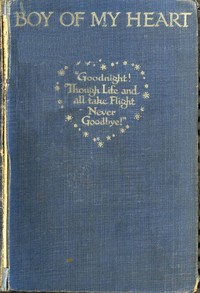
Boy of My Heart — Themes and Context can be approached with a clearer sense of reading commitment from its source measurements: 52,609 words, 3 hr 49 min estimated reading time, and 6 detected text sections.
The text analysis averages about 18.5 words per sentence, while the detected sections provide another way to judge how the source is divided.
Project Gutenberg metadata also associates the work with “World War, 1914-1918 -- Gift books,” connecting these edition facts with the source record’s subject description.
Explore this collection
These alternatives are selected using recorded categories and estimated reading time.
About 240 minutes
Modern Nations
55,054 recorded words. 11 minutes difference from this book's estimate.
View Gutenberg source #67393About 213 minutes
Modern Nations
48,836 recorded words. 16 minutes difference from this book's estimate.
View Gutenberg source #49350About 256 minutes
Modern Nations
58,842 recorded words. 27 minutes difference from this book's estimate.
View Gutenberg source #52308Search stored excerpts and compare books → Choose by your preferences →
Choices use stored catalog measurements. Estimates vary with reading speed. A shared category is a catalog label, not a claim that two books have the same argument or literary quality.
Search reads excerpt text stored with this catalog and links to its associated Gutenberg record. The connection is stored in the site database; this tool does not recheck that every excerpt is word-for-word identical to that external record. Excerpt search does not cover every chapter and does not verify historical publication dates.
Catalog snapshot checked: 2026-09-25. Coverage: 91 public books, 91 available source excerpts.
Read the complete public-domain text at its original source.
Read on Project GutenbergThe book opens not with a birth but with a mother waiting for dinner, a letter from her son in France open before her. This scene of suspended time—half-past nine, the meal delayed, the letter read and reread—establishes the central tension of the work: the domestic world held in abeyance by the war. The narrative will shuttle between this present of anxious waiting and the remembered past of the boy's childhood, a structure that gives each memory the weight of foreshadowing.
The opening chapter, titled 'Waiting,' is not merely a description of a moment but a key to the book's architecture. The mother sits with her son's letter, and the narrative then moves backward into memory. This pattern recurs: the present of the war intrudes upon recollections of croquet games, bedtime conversations, and nursery squabbles. The reader is never allowed to forget the endpoint. The phrase 'that splendid sound of marching feet' appears first in a childhood memory and is immediately undercut by the mother's retrospective knowledge: 'He was to hear it often enough in a very few years to come!' This technique of temporal layering gives even the most mundane episodes—a boy's tantrum over croquet, a sister's artistic ambitions—a poignant, almost unbearable resonance.
Certain images recur with deliberate frequency. Marching feet appear in the boy's childhood fascination with Territorials and later, implicitly, in his own soldier's tread. Letters are physical objects that bridge the gap between home and front; the mother's waiting is often for the post. The sea, or the coastal setting of 'Sunny Cliff,' serves as a boundary and a symbol of separation. The boy's pet name, 'Little Yeogh Wough,' and the mother's 'Big Yeogh Wough' suggest a private language that the war renders fragile. These recurring details are not merely decorative; they form a web of connections that bind the domestic and the martial, the past and the present.
The excerpts reveal a consistent portrait of the boy's temperament. His mother notes that he 'never could bear to be beaten at anything,' a trait the old nurse attributes to 'pride and vanity' rather than a love of truth. This driving force manifests in his reaction to losing at croquet—'proud, dignified unhappiness'—and in his refusal to make excuses. The mother's rebuke, 'An excuse is always worse than the thing it tries to cover up,' suggests a moral code that values accountability. Yet the boy is also capable of tenderness: his grave response to his mother's joke about falling in love—'I shall have to find a very special sort of girl before I leave you for her'—reveals a depth of attachment that makes his eventual departure for war all the more poignant.
The book's structure is marked by abrupt shifts in setting and tone. A chapter may begin with a domestic quarrel over croquet and end with a reflection on the sound of marching feet. The second part, titled 'The Two German Gifts,' signals a turn toward the war itself. The excerpts do not reveal the full content of these chapters, but the title suggests a framing of the conflict in personal, almost allegorical terms. The movement is not linear but associative: a memory of the boy's childhood temper leads to a meditation on his soldierly pride; a description of marguerites on the lawn becomes a reminder of 'Frenchy gaiety.' This fluidity mirrors the mother's consciousness, which cannot separate the boy she raised from the soldier he became.
Readers should attend to the book's deliberate use of repetition and contrast. The same phrases—'marching feet,' 'waiting,' 'pride'—appear in different contexts, gaining new meaning each time. The work is not a straightforward biography but a mosaic of memory, held together by the mother's voice. Its power lies in the tension between the ordinary details of a childhood and the extraordinary fate that awaits them.
I still think of that mother in Boy of My Heart, how she listened for her son’s step long after the letters stopped. The waiting—that quiet, terrible waiting—finds an echo in Ordeal by Battle — Themes and Context, where the same hush hangs over every preparation. They share a sadness, a held breath, as if both understand what pride costs. A tender pairing, those two. I’ve shelved them side by side for years.
A brief reflection can help important ideas stay with you longer.