About 229 minutes
Boy of My Heart — Themes and Context
Modern Nations
52,609 recorded words. 11 minutes difference from this book's estimate.
View Gutenberg source #51437
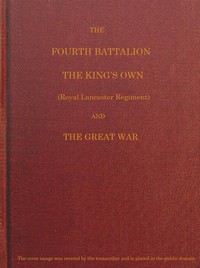
For The Fourth Battalion, The King's Own (Royal Lancaster Regiment) and the Great War — Reading Companion, the stored edition analysis reports 55,054 words, 4 hr estimated reading time, and 28 detected text sections.
The text analysis averages about 12.8 words per sentence, while the detected sections provide another way to judge how the source is divided.
Project Gutenberg metadata also associates the work with “World War, 1914-1918 -- Campaigns -- Western Front,” connecting these edition facts with the source record’s subject description.
Explore this collection
These alternatives are selected using recorded categories and estimated reading time.
About 229 minutes
Modern Nations
52,609 recorded words. 11 minutes difference from this book's estimate.
View Gutenberg source #51437About 256 minutes
Modern Nations
58,842 recorded words. 16 minutes difference from this book's estimate.
View Gutenberg source #52308About 213 minutes
Modern Nations
48,836 recorded words. 27 minutes difference from this book's estimate.
View Gutenberg source #49350Search stored excerpts and compare books → Choose by your preferences →
Choices use stored catalog measurements. Estimates vary with reading speed. A shared category is a catalog label, not a claim that two books have the same argument or literary quality.
Search reads excerpt text stored with this catalog and links to its associated Gutenberg record. The connection is stored in the site database; this tool does not recheck that every excerpt is word-for-word identical to that external record. Excerpt search does not cover every chapter and does not verify historical publication dates.
Catalog snapshot checked: 2026-09-25. Coverage: 91 public books, 91 available source excerpts.
Read the complete public-domain text at its original source.
Read on Project GutenbergThe opening chapter of this battalion history immediately establishes a dual voice: the foreword describes the work as 'notes compiled, more or less in the form of a diary,' and the first chapter confirms that impression with precise dates, train movements, and the 'shortest Annual Training on record.' The prose is brisk and administrative, noting that each Adjutant had 'burned much midnight oil' over mobilization schemes. This bureaucratic tone, however, gives way to starkly different rhythms once the unit reaches the front.
The early chapters read like a staff officer’s log: times of departure, names of brigade commanders, and the number of men dismissed to homes. The language is measured, almost detached. But by the account of the fighting near the Kansas Cross roads and the Green Line, the sentences shorten and the pace quickens. Phrases such as 'the enemy delivered a most determined counter-attack' and 'the Battalion, contesting, like the other units, every inch of ground, was compelled to withdraw' show a shift from recording to recounting. The diary form persists—dates and times remain—but the tone becomes more urgent, with fewer administrative asides and more direct action.
One of the most striking structural features is the insertion of officer casualty lists within the narrative. After describing the withdrawal to the Black Line and the collection of survivors—'about 150 in all'—the text lists by name each officer wounded, missing, or killed. This list interrupts the flow, forcing a pause. The effect is cumulative: the reader is not allowed to move past loss quickly. The same pattern recurs later, with names like Second-Lieut. G. W. Ford (killed) and Capt. H. A. Brocklebank (wounded and missing). These lists are not footnotes; they are part of the story, a deliberate choice that underscores the human cost behind the map coordinates.
Amid the grim accounting, the narrative occasionally includes a wry observation. After a narrow escape from a shell, the men receive a 'welcome rum ration—an indulgence which in a few instances produced curious effects!' The phrase is understated, almost a joke, but it reveals the strain. Similarly, the description of the camp at Watou as 'a quagmire' where 'exhausted troops threw themselves down thankfully and were soon oblivious to their discomforts' conveys physical exhaustion without melodrama. These details—the rum, the mud, the sleep—ground the account in bodily experience, reminding the reader that this is a record of men, not just maneuvers.
Readers should pay attention to the shifts in sentence length and detail density. The early chapters reward those interested in mobilization logistics; the later ones demand a slower reading to absorb the casualty lists and the terse descriptions of withdrawal. The book is best approached as a primary source—a compilation of notes that preserves the voice of its compilers, with all their omissions and emphases intact.
That wet Wednesday, I kept returning to the mud of Festubert in the battalion diary, the dry casualty lists oddly moving. Later, staring at rain on the window, I found myself wondering what all that sacrifice was supposed to settle. That’s how I ended up with Some Problems of the Peace Conference — Background and Themes, a quieter volume, but it felt like picking up the same conversation.
Build a private reading journal entry for this title.