About 331 minutes
Some Problems of the Peace Conference — Background and Themes
Modern Nations
76,104 recorded words. 0 minutes difference from this book's estimate.
View Gutenberg source #67688
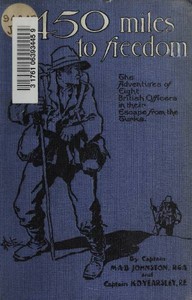
The catalog record for Four-Fifty Miles to Freedom — Key Ideas to Explore provides practical reading context through 76,042 words, 5 hr 31 min estimated reading time, and 8 detected text sections.
The text analysis averages about 22.3 words per sentence, while the detected sections provide another way to judge how the source is divided.
Project Gutenberg metadata also associates the work with “World War, 1914-1918 -- Prisoners and prisons, Turkish,” connecting these edition facts with the source record’s subject description.
Explore this collection
These alternatives are selected using recorded categories and estimated reading time.
About 331 minutes
Modern Nations
76,104 recorded words. 0 minutes difference from this book's estimate.
View Gutenberg source #67688About 358 minutes
Modern Nations
82,164 recorded words. 27 minutes difference from this book's estimate.
View Gutenberg source #57287About 299 minutes
Modern Nations
68,574 recorded words. 32 minutes difference from this book's estimate.
View Gutenberg source #51551Search stored excerpts and compare books → Choose by your preferences →
Choices use stored catalog measurements. Estimates vary with reading speed. A shared category is a catalog label, not a claim that two books have the same argument or literary quality.
Search reads excerpt text stored with this catalog and links to its associated Gutenberg record. The connection is stored in the site database; this tool does not recheck that every excerpt is word-for-word identical to that external record. Excerpt search does not cover every chapter and does not verify historical publication dates.
Catalog snapshot checked: 2026-09-25. Coverage: 91 public books, 91 available source excerpts.
Read the complete public-domain text at its original source.
Read on Project GutenbergThe opening poem, 'Prisoner of War,' establishes a sardonic refrain—'Then thank God you're not a prisoner of war'—that the prose will echo in a lower key. The narrative voice is that of a British officer who treats extreme hardship with a blend of matter-of-factness and understated wit. When the authors describe a halt to cook rice and cocoa, they pause for a 'dissertation upon mugs,' weighing the merits of aluminium versus enamel with the same seriousness they apply to route-finding. This tonal shift—from the poem's bitter irony to the prose's dry practicality—is the book's defining stylistic feature.
Co-authorship is rarely invisible, but here the first-person plural 'we' creates a seamless collective narrator. The voice is that of a single consciousness, yet it carries the authority of two men who endured the same events. The prose is unadorned: 'The heat was already terrific' is typical. There is no attempt to dramatize; the drama is inherent in the situation. The authors trust the reader to recognize the gravity of a 'parched plain' that would 'need a Moses' wand to make it bring forth water.' The biblical allusion is the only flourish, and it is earned by the context.
The excerpt shows a deliberate manipulation of pace. Long, detailed passages about the landscape and the party's calculations—'eighteen miles to the Well of Moses were still before us'—create a sense of slogging progress. Then, abruptly, the pace quickens with a single sentence: 'A horrible suspicion entered our minds.' The suspicion is confirmed, and the narrative slows again to describe the 'hump-backed bridge of some antiquity.' This rhythm—accumulation, crisis, reflection—mirrors the psychological experience of escape, where hope and disappointment alternate.
The authors build character through objects and their failings. Looney's aluminium mug 'burns the fingers,' Perce's ovaltine tin is unstable, and Cochrane's mug retrieves 'decomposed cockroaches.' These items are not mere props; they are sources of conflict and humor. The mug 'dissertation' is a digression that reveals the men's priorities: comfort and efficiency in the face of chaos. Similarly, the 'old khan or inn' that turns out to be in ruins is a recurring motif—promise that becomes disappointment. The authors do not moralize; they simply record, letting the reader infer the toll of such repeated letdowns.
The desert is not a backdrop but an active opponent. The authors personify it sparingly: the 'parched plain' mocks them with mirage, and the 'broad white bed of a dried-up river' forces a recalculation of distance. The map itself is unreliable, writing 'the name vaguely across the desert without committing itself to any definite spot.' This distrust of cartography underscores the gap between planning and reality. The landscape's indifference is conveyed through precise physical details—the 'scorched prairie land,' the 'sun-dried blocks of mud' used as a fireplace—rather than through emotional language.
Readers should attend to the interplay between the poem's refrain and the prose's restraint. The book does not wear its suffering on its sleeve; it embeds it in the mundane—a mug, a well, a misjudged distance. The co-authors' unified voice suggests a deliberate editorial hand, likely smoothing individual quirks into a consistent tone. For those interested in the psychology of endurance, the value lies not in the escape's outcome but in the daily texture of the attempt.
That account of the escape stuck with me—how they’d treat a broken well like a joke but grumble about a mug’s design for pages. It made me think about how we carry small comforts into chaos. Later, I found Some Problems of the Peace Conference — Background and Themes, and it felt like the same quiet voice, trying to make sense of what comes after the fighting, one dry observation at a time.
Capture what you thought, learned, and would like to remember.