About 73 minutes
The Dardanelles: Colour Sketches From Gallipoli — A Reader’s Guide
Modern Nations
16,729 recorded words. 6 minutes difference from this book's estimate.
View Gutenberg source #48754
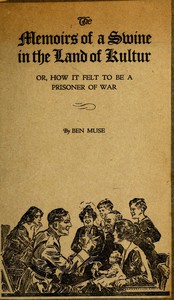
The Memoirs of a Swine in the Land of Kultur; or, How it Felt to be a Prisoner of War — A Closer Reading can be approached with a clearer sense of reading commitment from its source measurements: 15,278 words, 1 hr 7 min estimated reading time, and 21 detected text sections.
The text analysis averages about 16.6 words per sentence, while the detected sections provide another way to judge how the source is divided.
Project Gutenberg metadata also associates the work with “World War, 1914-1918 -- Personal narratives,” connecting these edition facts with the source record’s subject description.
Explore this collection
These alternatives are selected using recorded categories and estimated reading time.
About 73 minutes
Modern Nations
16,729 recorded words. 6 minutes difference from this book's estimate.
View Gutenberg source #48754About 58 minutes
Modern Nations
13,308 recorded words. 9 minutes difference from this book's estimate.
View Gutenberg source #60361About 77 minutes
Modern Nations
17,579 recorded words. 10 minutes difference from this book's estimate.
View Gutenberg source #53814Search stored excerpts and compare books → Choose by your preferences →
Choices use stored catalog measurements. Estimates vary with reading speed. A shared category is a catalog label, not a claim that two books have the same argument or literary quality.
Search reads excerpt text stored with this catalog and links to its associated Gutenberg record. The connection is stored in the site database; this tool does not recheck that every excerpt is word-for-word identical to that external record. Excerpt search does not cover every chapter and does not verify historical publication dates.
Catalog snapshot checked: 2026-09-25. Coverage: 91 public books, 91 available source excerpts.
Read the complete public-domain text at its original source.
Read on Project GutenbergBen Muse’s 1918 memoir, written under the deliberately provocative title The Memoirs of a Swine in the Land of Kultur, opens not with a declaration of heroism but with a mundane detail: the interruption of his breakfast preparations. Bandaging a wounded comrade, he notes that his biscuits, jam, and chocolate were laid out, and the tea-water over his boot-dubbin fire “steadily refused to boil.” This blend of the horrific and the quotidian sets the tone for a narrative that treats captivity as a series of absurd encounters and small indignities rather than a tale of high drama.
Muse’s narrative voice is consistently ironic and self-mocking. He describes himself as a “swine” in the preface, a label that undercuts any pretension to martyrdom. When captured, he notes that the German who apprehends him is “armed to the teeth” and compares him to Don Quixote, a knight errant of a lost cause. Even in a civilian jail, he turns his situation into a comedy: his singing is prohibited not by prison rules but by “the peculiar quality of my singing.” This humor is a deliberate rhetorical strategy, one that distances the reader from the grim reality of starvation and confinement while still conveying the monotony and deprivation of POW life.
The catalog lists this work under “World War, 1914-1918 – Personal narratives” and “World War, 1914-1918 – Prisoners and prisons, German.” While accurate, these labels do not capture the memoir’s emphasis on the author’s American identity and his status as a volunteer in the British army. Muse repeatedly highlights his nationality: he carries a small American flag in his wallet, and the German interrogator is puzzled by his “English Certificate of Attestation.” The narrative is less about the German prison system per se than about the author’s navigation of multiple identities—American, British soldier, escaped prisoner—in a landscape of shifting allegiances.
Throughout the excerpts, Muse’s attention to food and clothing is relentless. He hoards provisions, trades for better coats, and notes the precise contents of his rations: a hunk of bread, a slice of bacon, a cup of “German coffee.” When he is recaptured and jailed, the warden gives him extra food because his son “had formerly worked in England.” Other prisoners beg for bread through a peephole. These small, concrete details—the weight of a coat, the taste of ersatz coffee—ground the memoir in the physical reality of survival, making the abstract category “prisoner of war” tangible through the body’s needs.
Readers should approach this memoir as a deliberately crafted performance, not a transparent record. Muse’s ironic tone and selective detail shape the story as much as the events themselves. The gaps in the excerpts—how he escaped, how he was recaptured—are left for the full text to reveal, but the voice remains consistent: a young man determined to find humor in humiliation and to assert his individuality against the machinery of war.
There’s a particular ache in reading how soldiers held onto small dignities—a mended sock, a scrap of food—that makes me think of the men in A Sketch of the 29th Regiment of Connecticut Colored Troops — Background and Themes. They carried that same quiet defiance through worse odds, and I find myself wondering how they remembered home. A Sketch of the 29th Regiment of Connecticut Colored Troops — Background and Themes stays with me like that—not loudly, just there.
Build a private reading journal entry for this title.