About 104 minutes
The White Road of Mystery: The Note-Book of an American Ambulancier — Key Ideas to Explore
Modern Nations
23,889 recorded words. 7 minutes difference from this book's estimate.
View Gutenberg source #59102
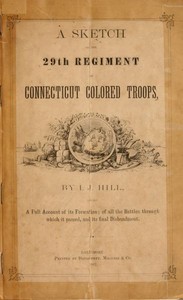
Before opening A Sketch of the 29th Regiment of Connecticut Colored Troops — Background and Themes, the edition data offers a quick orientation: 22,188 words, 1 hr 37 min estimated reading time, and 2 detected text sections.
The text analysis averages about 18.8 words per sentence, while the detected sections provide another way to judge how the source is divided.
Project Gutenberg metadata also associates the work with “United States -- History -- Civil War, 1861-1865 -- Regimental histories,” connecting these edition facts with the source record’s subject description.
Explore this collection
These alternatives are selected using recorded categories and estimated reading time.
About 104 minutes
Modern Nations
23,889 recorded words. 7 minutes difference from this book's estimate.
View Gutenberg source #59102About 88 minutes
Modern Nations
20,097 recorded words. 9 minutes difference from this book's estimate.
View Gutenberg source #62266About 77 minutes
Modern Nations
17,579 recorded words. 20 minutes difference from this book's estimate.
View Gutenberg source #53814Search stored excerpts and compare books → Choose by your preferences →
Choices use stored catalog measurements. Estimates vary with reading speed. A shared category is a catalog label, not a claim that two books have the same argument or literary quality.
Search reads excerpt text stored with this catalog and links to its associated Gutenberg record. The connection is stored in the site database; this tool does not recheck that every excerpt is word-for-word identical to that external record. Excerpt search does not cover every chapter and does not verify historical publication dates.
Catalog snapshot checked: 2026-09-25. Coverage: 91 public books, 91 available source excerpts.
Read the complete public-domain text at its original source.
Read on Project GutenbergIsaac J. Hill opens his regimental history not with a battlefield but with his own birth in 1826 to a poor family in Selings Grove, Pennsylvania. He explains that as a Black child he was denied schooling by Kentucky law, learning to read and write only through the help of white friends. This personal preface establishes the author as both a participant and a chronicler, grounding the military narrative that follows in a lived experience of racial restriction and self-education. Hill’s voice—direct, devout, and occasionally homiletic—shapes every page, making the sketch as much a spiritual testimony as a tactical record.
Hill’s preface does more than introduce; it declares his purpose. He writes that his “sole aim is to promote the happiness of the human family, here and hereafter,” and he urges readers to approach the book “impartially and carefully.” This moral framing is reinforced by his account of his own path: born in Pennsylvania, bound out to a Kentucky gentleman at age six, denied formal education, yet learning to read and write through “diligent study.” He embraced religion in 1846 and was called to the ministry in 1852. When the war began, he served with the 3rd Pennsylvania Cavalry, then enlisted in the 29th Connecticut in January 1863. The preface thus positions the regimental history as an extension of Hill’s dual vocation as soldier and minister, and it signals that the book will treat military events as part of a larger moral and spiritual struggle.
The most striking passage in the excerpts describes President Lincoln’s entry into Richmond after its fall. Hill records the scene in precise detail: Lincoln walked over a mile to General Weitzel’s headquarters at Jefferson Davis’s mansion, led by a colored guide, flanked by six soldiers in blue and six sailors. Thousands of people, colored and white, filled the streets. Hill captures the reactions of Black residents—one woman shouted “Glory to God,” another threw her bonnet in the air screaming “Thank you, Master Lincoln”—and notes that a white woman turned away “as if it were a disgusting sight.” Hill’s own voice emerges in commentary: “It was a man of the people among the people. It was a great deliverer among the delivered.” He also reports Lincoln’s speech to the colored people, in which the President declared, “God has made you free… take the sword and bayonet and teach them that you are.” This episode, drawn from Hill’s personal observation, gives the reader a rare, ground-level view of a pivotal moment.
The excerpts suggest that Hill alternates between firsthand testimony and compiled regimental records. His prose is plain but not artless; he uses repetition for emphasis (“Thank God for his goodness; we have seen his salvation”) and shifts between reported speech and his own reflections. The account of the 25th Corps moving to Petersburg includes a telling detail: as the troops marched in the rain, Hill could hear what “the rebels said as they stood on the corners,” including the remark, “We never were protected until the colored troops came here.” This inclusion of enemy voices is unusual and suggests Hill’s effort to present a multifaceted picture. The book’s structure, as indicated by the title page, promises “a Full Account of its Formation; of all the Battles through which it passed, and its final Disbandment,” but the surviving excerpts focus more on the Richmond episode than on combat, leaving the reader to infer that the battle narratives may be more compressed.
Because the excerpts are incomplete, the reader should treat the book as a primary document rather than a comprehensive history. Hill’s preface and the Richmond scene are the most fully preserved sections; the battle accounts are only hinted at. The author’s dual role—as a Black soldier and a minister—shapes his perspective, and his language often carries a devotional tone. Readers should note that Hill explicitly addresses his audience with a prayer for blessing, and that he frames the war as part of a divine plan for the “unfortunate African.” This religious lens is integral to the work, not a decorative addition. The sketch is valuable for its insider view of the 29th Connecticut and for the unmediated voice of a 19th-century African American veteran writing just two years after the war’s end.
Hill’s sketch rewards a patient reading that attends to his distinctive voice and his placement of military events within a moral and spiritual framework. The Richmond episode, in particular, offers a rare firsthand account of Lincoln’s reception by the city’s Black population. Readers should be aware that the surviving text is partial; the battle narratives that Hill promised may be less detailed than the personal and observational passages. Approach the book as a memoir-inflected regimental history, and let Hill’s own words—his prayers, his observations, his quiet pride—guide your reading.
Years at the reference desk taught me that courage rarely speaks loudly. Isaac J. Hill’s quiet record of the 29th Connecticut, his hand steady as Lincoln’s carriage rolls past, hums with the same restrained dignity I found in Brave Belgians — Context and Discussion. Both are simply men noting what they endured, and I find myself holding that shared whisper close.
Answer a few questions and save a private reflection on this device.