About 97 minutes
A Sketch of the 29th Regiment of Connecticut Colored Troops — Background and Themes
Modern Nations
22,188 recorded words. 7 minutes difference from this book's estimate.
View Gutenberg source #60700
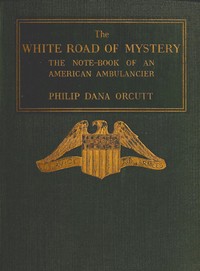
The White Road of Mystery: The Note-Book of an American Ambulancier — Key Ideas to Explore can be approached with a clearer sense of reading commitment from its source measurements: 23,889 words, 1 hr 44 min estimated reading time, and 11 detected text sections.
The text analysis averages about 24.0 words per sentence, while the detected sections provide another way to judge how the source is divided.
Project Gutenberg metadata also associates the work with “World War, 1914-1918 -- Personal narratives, American,” connecting these edition facts with the source record’s subject description.
Explore this collection
These alternatives are selected using recorded categories and estimated reading time.
About 97 minutes
Modern Nations
22,188 recorded words. 7 minutes difference from this book's estimate.
View Gutenberg source #60700About 88 minutes
Modern Nations
20,097 recorded words. 16 minutes difference from this book's estimate.
View Gutenberg source #62266About 77 minutes
Modern Nations
17,579 recorded words. 27 minutes difference from this book's estimate.
View Gutenberg source #53814Search stored excerpts and compare books → Choose by your preferences →
Choices use stored catalog measurements. Estimates vary with reading speed. A shared category is a catalog label, not a claim that two books have the same argument or literary quality.
Search reads excerpt text stored with this catalog and links to its associated Gutenberg record. The connection is stored in the site database; this tool does not recheck that every excerpt is word-for-word identical to that external record. Excerpt search does not cover every chapter and does not verify historical publication dates.
Catalog snapshot checked: 2026-09-25. Coverage: 91 public books, 91 available source excerpts.
Read the complete public-domain text at its original source.
Read on Project GutenbergPhilip Dana Orcutt’s The White Road of Mystery opens with a preface that frames the ambulance driver’s position as uniquely exposed—comparable to a grouse in open season—and emphasizes the volunteer nature of the American Field Service before U.S. government takeover. The book’s title, drawn from the first chapter, evokes a sense of uncertain journey along a road that is both literal and metaphorical. Orcutt, a member of Section XXXI, writes from direct experience, weaving observations from moving between sectors and battles. The excerpts show a voice that is matter-of-fact yet vivid, mixing technical details of ambulance work with broader commentary on the war’s human landscape.
The book is explicitly a “note-book,” as stated in the subtitle, and its chapter headings—The White Road of Mystery, In Action, En Repos, At the Front, L’Envoi—suggest a chronological or thematic progression from arrival to departure. The opening excerpts place the reader in a specific morning scene: “The sweet, clear notes of a bugle come faintly up to me through the cool air of morning.” This sensory detail establishes a quiet, observant tone before the narrative moves into action. Orcutt does not rush into combat; he first sets the atmosphere, allowing the reader to sense the pause before duty.
Orcutt devotes considerable space to classifying Allied troops by temperament, distinguishing between “flying” and “holding” divisions. He notes that some troops excel in charges but lack stamina, while others hold ground tenaciously. This analysis is grounded in specific examples: Madagascan colonial troops who abandoned trenches when supper was delayed, then recaptured them after eating; the Foreign Legion’s boast of never failing to reach its objective, illustrated by an attack where 35,000 entered and 3,500 returned. These anecdotes are not merely colorful; they reflect Orcutt’s role as a mobile observer, moving between sectors and noting patterns in behavior.
Several excerpts highlight interactions with Algerian and other colonial troops, revealing both humor and tension. One story recounts an Algerian wounded soldier who, while riding in an ambulance, wanted to stab a German prisoner with a long knife, sulking when the driver refused. Another Algerian shared a joke about tricking three prisoners into a roofless ruin and tossing grenades at them. These vignettes show Orcutt’s willingness to record morally ambiguous moments without judgment, presenting the war’s brutality through the perspectives of those he transported. The tone remains observational, not sensationalized.
Orcutt repeatedly emphasizes that the ambulance driver’s mobility grants a broader view than most soldiers: “the ambulance driver must always be in the warmest places, and has a really unusual opportunity to observe by moving from sector to sector and battle to battle.” This claim is supported by the range of subjects in the excerpts—from tactical classifications to personal anecdotes. The book’s structure as a notebook reinforces this episodic, on-the-ground quality. Readers should expect a collection of scenes rather than a continuous narrative, with each chapter offering a distinct facet of life in the zone.
Orcutt’s note-book resists a single storyline; instead, it presents a series of sharply observed moments. For a first reading, pay attention to how the author shifts between broad analysis and intimate detail, and note the recurring motif of roads and movement. The glossary included at the end suggests that some terms may be unfamiliar, but the prose itself is direct. Approach the book as a contemporary document that captures one volunteer’s view of a vast conflict, without expecting a complete history.
Reading the ambulance notebook, I kept thinking about the quiet dignity in that other volume, A Sketch of the 29th Regiment of Connecticut Colored Troops — Background and Themes, how both men simply wrote down what they saw—mud, fear, small kindnesses—without grand speeches. That plain record-keeping feels like a hand held out across the years, asking nothing, just witnessing. Strange, how two wars can share one heartbeat.
Build a private reading journal entry for this title.