About 367 minutes
Day by Day with the Russian Army, 1914-15 — Text and Context
World Events
84,360 recorded words. 21 minutes difference from this book's estimate.
View Gutenberg source #55702
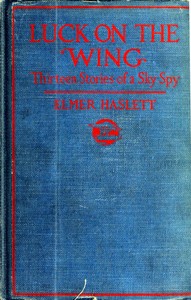
The catalog record for Luck on the Wing: Thirteen Stories of a Sky Spy — Reading Notes provides practical reading context through 89,074 words, 6 hr 28 min estimated reading time, and 18 detected text sections.
The text analysis averages about 23.9 words per sentence, while the detected sections provide another way to judge how the source is divided.
Project Gutenberg metadata also associates the work with “World War, 1914-1918 -- Personal narratives, American,” connecting these edition facts with the source record’s subject description.
Explore this collection
These alternatives are selected using recorded categories and estimated reading time.
About 367 minutes
World Events
84,360 recorded words. 21 minutes difference from this book's estimate.
View Gutenberg source #55702About 360 minutes
World Events
82,640 recorded words. 28 minutes difference from this book's estimate.
View Gutenberg source #51427About 419 minutes
World Events
96,251 recorded words. 31 minutes difference from this book's estimate.
View Gutenberg source #50379Search stored excerpts and compare books → Choose by your preferences →
Choices use stored catalog measurements. Estimates vary with reading speed. A shared category is a catalog label, not a claim that two books have the same argument or literary quality.
Search reads excerpt text stored with this catalog and links to its associated Gutenberg record. The connection is stored in the site database; this tool does not recheck that every excerpt is word-for-word identical to that external record. Excerpt search does not cover every chapter and does not verify historical publication dates.
Catalog snapshot checked: 2026-09-25. Coverage: 91 public books, 91 available source excerpts.
Read the complete public-domain text at its original source.
Read on Project GutenbergElmer Haslett opens his 1920 memoir with a frank admission: he had a 'holy horror of airplanes' and originally wanted to be an infantryman. This disarming honesty sets the tone for a narrative that is less about aerial glory and more about the peculiar, high-stakes work of a 'sky spy'—an aerial observer directing artillery fire. The book's thirteen stories are built around specific missions, each rendered with a technician's attention to coordinates, signal codes, and the agonizing seconds before a 'zone fire' order. Haslett's voice is that of a man who found himself in the air by circumstance, not passion, and his account gains authority from its reluctance to romanticize the role.
Haslett's descriptions of his work are studded with technical detail that reveals the observer's craft as a blend of mathematics, patience, and nerve. In one extended episode, he spends nearly an hour adjusting two batteries onto a temporary target, only to shift their aim by 'three hundred meters' when a more valuable target appears—a column of men and horses converging at a road fork. He wires repeatedly, 'Is battery ready?' while the columns close, and notes the absence of a code for 'Hurry up.' The passage is a study in controlled urgency: the observer must calculate deflection, communicate coordinates, and decide the moment to fire, all while the enemy moves below. Haslett does not gloss over the difficulty; he makes the reader feel the weight of each correction and the frustration of waiting for a battery to signal readiness.
Haslett's most striking passages are those where he confronts the human cost of his work. Before giving the signal to fire on the column, he compares himself to 'the warden of the penitentiary about to press the fatal buzzer that sends the doomed soul to his death.' The simile is deliberate and unsettling, and Haslett does not shy from enumerating what he imagines: 'the crushing out of their lives, the blighting of the hopes of many fond sweethearts, the wrecking of many homes and the grief of many mothers.' Yet he also records that these thoughts were 'strangely enough only passing thoughts,' and he gives the order. The tension between empathy and duty is left unresolved, and the memoir does not offer easy moral framing. Instead, it presents the observer's dilemma as a practical one: the target is there, the guns are ready, and 'C'est la Guerre.'
Haslett's prose is direct and unadorned, often self-deprecating. He admits that his decision to transfer from infantry to aviation was driven not by a love of flying but by a desire to reach the front quickly, and that he 'cannot say that I exactly enjoy riding in them.' This reluctance gives his observations a grounded quality; he is not a thrill-seeker but a soldier doing a job. His explanations of aerial observation are laced with the jargon of the trade—'zone fire,' 'deflection,' 'coordinate location'—but he takes care to define terms for the civilian reader. The voice is that of a man who has seen the mechanics of war up close and is willing to describe them without false bravado. The introduction by General William Mitchell adds a layer of official endorsement, but Haslett's own words carry the weight of experience.
The book is organized as a series of thirteen stories, each presumably centered on a specific flight or operation. This episodic structure allows Haslett to focus on particular moments of tension—the adjustment of fire, the identification of a target, the wait for a signal—without needing to construct a continuous narrative. The excerpts suggest that each story builds toward a decisive action, often involving artillery coordination. The reader is placed in the observer's seat, looking down at the road fork, the columns, the panels laid out by the batteries. The memoir does not attempt to cover the entire war or the author's full career; it selects scenes that illustrate the observer's role in its most concentrated form. This selectivity gives the book a tight, almost technical focus, emphasizing the craft over the campaign.
Readers approaching Luck on the Wing should expect a memoir that privileges operational detail over personal narrative. Haslett's stories are best read as case studies in the observer's trade, each one a lesson in the coordination of air and ground fire. The emotional weight is present but understated, carried in the spaces between technical instructions. Pay attention to the moments when the author pauses to reflect—they are rare and therefore telling.
Elmer’s patient arithmetic of shells and winds reminded me of sitting with my grandfather, who never spoke of the Somme. He’d only trace the lines in a worn Bible. That same quiet steadiness came back when I later lingered over With the Ulster Division in France A Story of the 11th Battalion Royal Irish Rifles (South Antrim Volunteers), From Bordon to Thiepval. — Reading Notes — not glory, just men holding on.
Save your reaction, strongest insight, and memorable passage.