About 367 minutes
Day by Day with the Russian Army, 1914-15 — Text and Context
World Events
84,360 recorded words. 7 minutes difference from this book's estimate.
View Gutenberg source #55702
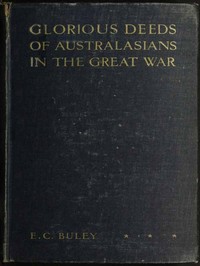
The source record for Glorious Deeds of Australasians in the Great War — Edition Insights measures this digital text at 82,640 words, 6 hr estimated reading time, and 33 detected text sections.
The text analysis averages about 21.4 words per sentence, while the detected sections provide another way to judge how the source is divided.
Project Gutenberg metadata also associates the work with “World War, 1914-1918 -- Campaigns -- Turkey -- Gallipoli Peninsula,” connecting these edition facts with the source record’s subject description.
Explore this collection
These alternatives are selected using recorded categories and estimated reading time.
About 367 minutes
World Events
84,360 recorded words. 7 minutes difference from this book's estimate.
View Gutenberg source #55702About 333 minutes
World Events
76,552 recorded words. 27 minutes difference from this book's estimate.
View Gutenberg source #49509About 388 minutes
World Events
89,074 recorded words. 28 minutes difference from this book's estimate.
View Gutenberg source #59987Search stored excerpts and compare books → Choose by your preferences →
Choices use stored catalog measurements. Estimates vary with reading speed. A shared category is a catalog label, not a claim that two books have the same argument or literary quality.
Search reads excerpt text stored with this catalog and links to its associated Gutenberg record. The connection is stored in the site database; this tool does not recheck that every excerpt is word-for-word identical to that external record. Excerpt search does not cover every chapter and does not verify historical publication dates.
Catalog snapshot checked: 2026-09-25. Coverage: 91 public books, 91 available source excerpts.
Read the complete public-domain text at its original source.
Read on Project GutenbergE. C. Buley's Glorious Deeds of Australasians in the Great War opens with a preface that establishes a deliberate restraint: the author interviewed hundreds of wounded soldiers in London hospitals but chose to omit most individual acts of gallantry, noting that the force suffered 25,000 casualties in under five months and that official awards were practically suspended after April. This framing sets up a tension between the collective heroism Buley insists upon and the specific, vivid combat narratives that follow. The prose in the battle scenes shifts markedly—from the measured, almost bureaucratic tone of the preface to a breathless, detail-packed style that tracks movements, positions, and casualties with cinematic precision. The account of Albert Jacka's trench fight, for instance, moves through a series of rapid actions: holding a traverse, rushing to the rear, killing five with rifle shots and two with bayonet. The language becomes tactile and urgent, a deliberate contrast to the opening modesty.
Buley's preface is not merely an introduction but a methodological statement. He explains that he gathered material from soldiers' narratives, delivered with a modesty he did not seek to reproduce. This admission shapes the reader's expectations: the book will foreground action over personality, and the author will resist the temptation to single out individuals. Yet the preface also reveals a paradox—Buley collected many remarkable instances of gallantry but concluded that mentioning them would be invidious, since the bulk of such exploits had not come under his notice. The exception is Private Simpson, the ambulance hero, whom Buley says every Australasian describes as having earned the V.C. a dozen times. This selective exception underscores the author's awareness of his own editorial choices. The preface thus functions as a pact: the reader is told that the book will be both comprehensive and deliberately incomplete, a record shaped by the limits of what Buley could hear and choose to include.
The battle narratives in Glorious Deeds are marked by a distinctive rhythm: long, accumulating sentences that pile up actions and locations, then break into short, staccato statements of consequence. In the account of the Lone Pine counter-attack, Buley writes that Captain Shout, after pushing down a barricade, went forward with Captain Sass, one shooting and one bombing. The prose tracks the sound of bombs, the bustle of accoutrements, scrambling cries around a corner. Then, abruptly: Shout tried to light three bombs at once; one burst as it left his hand, shattering his hand, destroying an eye, scoring his breast and leg. The shift from fluid movement to sudden, graphic injury is characteristic of Buley's method. He does not dwell on the aftermath—Shout remains conscious, talks cheerfully, drinks tea, sends a message to his wife—but the violence is rendered with a matter-of-factness that mirrors the soldiers' own reported composure. This alternation between rapid action and stark consequence gives the prose a documentary urgency.
Throughout the excerpts, Buley's narrative voice oscillates between the impersonal and the intimate. He refers to the Australasian force as a collective entity—'this comparatively small force'—and uses phrases like 'the men of Anzac' to maintain a group identity. Yet within that collective, individual names and actions emerge: Lieutenant Hamilton, Howard, De Gruchy, Jacka, Captain Shout, Captain Sass. The prose often shifts from a general statement to a specific, named action without transition, as if the individual is an embodiment of the group. For example, after describing the general impossibility of awarding V.C.s, Buley lists Shout as foremost among those who received the honor in August, then immediately recounts his earlier Military Cross. This technique creates a layered effect: the reader is reminded that the narrative is always about the many, even when it zooms in on the few. The voice remains that of a compiler, not a participant, but the accumulation of names and deeds gives the text a memorial quality, as if Buley is building a verbal monument from fragments of testimony.
Readers approaching Glorious Deeds should attend to the shifts in register between the preface and the battle narratives, as these reveal Buley's editorial hand at work. The book is not a seamless chronicle but a constructed account that negotiates between the author's stated reluctance to individualize and the compelling pull of specific acts of courage. Noting how Buley handles transitions—from general statements to particular incidents, from collective to individual—will deepen one's understanding of how wartime propaganda and personal testimony intersect in this text.
That old Buley volume, with its rifle-fire sentences and stunned hospital silences, always leaves me thinking about what soldiers carry home unseen. A quieter book sits beside it now, Luck on the Wing: Thirteen Stories of a Sky Spy — Reading Notes, where the sky’s loneliness hums beneath each escapade. Different wars, same hush between deeds.
Create a short personal record of your experience with this book.