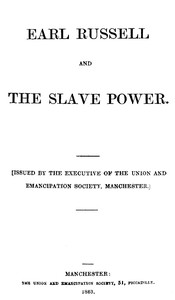
The pamphlet opens with a direct accusation: Earl Russell, the British Foreign Secretary, is charged with favoring the Confederate cause under the guise of neutrality. The author immediately establishes a combative tone, contrasting Russell's deference to the United States while it was united with his alleged provocations after secession. The text is structured as a prosecutorial brief, marshaling evidence from diplomatic correspondence, newspaper reports, and parliamentary statements.
The narrative voice is that of an indignant citizen, not a detached historian. It uses rhetorical questions, sarcasm, and historical analogies—comparing British treatment of the U.S. to its treatment of weaker nations like Burma and China. The pace accelerates from measured critique to urgent alarm, culminating in a warning that war is inevitable unless British policy changes.
A Voice of Moral Outrage
The pamphlet’s language is deliberately provocative, employing words like “impertinent,” “infamous,” and “cold reply” to characterize Earl Russell’s actions. The author does not merely disagree with policy; he impugns motives, suggesting that Russell’s leniency toward the Confederacy stems from a desire to weaken the United States. This is not a neutral analysis but a polemic aimed at swaying public opinion.
The tone shifts between legalistic precision and emotional appeal. For instance, the author notes that the Alabama was “manned by the Queen’s artillerymen” and “suffered to escape” with less energy than was used against “Hale’s rockets.” Such details are chosen to imply official complicity. The repeated use of the word “connivance” underscores the charge of deliberate negligence.
The author also employs sarcasm: after describing Russell’s acknowledgment that the Alabama was unlawful, he asks, “was it not his duty to ask or to take power to stop it?” The effect is to portray Russell as either incompetent or duplicitous. This rhetorical strategy keeps the reader engaged and reinforces the pamphlet’s central argument.
Evidence and Argumentation
The pamphlet builds its case through a series of specific incidents, each presented as evidence of bias. The Trent affair is cited as a moment when Russell yielded to the U.S. but then “proceeded as if to pick a new quarrel” over ships sunk in Charleston harbor. The author contrasts this with British actions toward weaker nations, implying a double standard.
Another key piece of evidence is the supply of Enfield rifles to the Confederacy, marked with the Queen’s symbol. The author argues that such items could only have been sold or given “by connivance of the Queen’s servants.” This is not a mere accusation but an inference drawn from the fact that “subordinates in England never take such liberties” without believing it will be acceptable to superiors.
The pamphlet also references the capture of New Orleans as a turning point, after which British policy improved “wonderfully.” This admission adds nuance, acknowledging that events could alter behavior. However, the overall thrust remains critical, with the author concluding that Russell’s actions have encouraged the South to build a fleet of 40–50 ships and raise a loan in London.
Escalating Warnings and a Call to Action
The final section shifts from accusation to warning. The author quotes the New York Times stating that “war will come, sooner or later, unless these wrongs are stopped by England.” This is presented as a credible threat, not an idle one. The pamphlet’s pace quickens, with shorter sentences and more direct appeals to the reader.
The author asks Englishmen to “meditate what will follow, if these ships also get out.” This is a call to public vigilance, implying that the government’s actions have consequences for national security. The pamphlet ends not with a conclusion but with an implied question: will the British public allow this to continue?
The structure mirrors a legal closing argument, summarizing the evidence and urging the jury—the reader—to act. The author does not propose specific remedies but leaves the reader with a sense of urgency. The final lines, though cut off in the excerpt, likely reinforce the warning that continued inaction will lead to war.
This pamphlet is best read as a primary source on British public opinion during the American Civil War. Its rhetorical strategies—moral outrage, selective evidence, and escalating warnings—reveal how the Union and Emancipation Society sought to mobilize sentiment against Earl Russell’s policies. Readers should note that the text is a polemic, not an impartial history, and should consider the counterarguments that Russell might have offered. The pamphlet’s value lies in its vivid depiction of the passions and arguments of the era.
I sometimes think of that 1863 pamphlet, all its righteous fury over Earl Russell’s leanings, and then I wander to the other shelf where The Comanches: A History of White's Battalion, Virginia Cavalry — Text and Context rests. Both whisper of men convinced they saw the truth, equally certain, equally doomed. A quiet kinship of conviction, perhaps.