About 465 minutes
The German Army in Belgium, the White Book of May 1915 — Reading Notes
Modern Nations
106,877 recorded words. 39 minutes difference from this book's estimate.
View Gutenberg source #54296
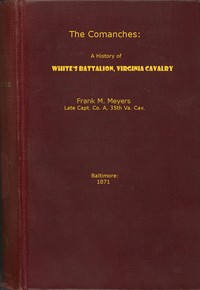
The catalog record for The Comanches: A History of White's Battalion, Virginia Cavalry — Text and Context provides practical reading context through 97,895 words, 7 hr 6 min estimated reading time, and 23 detected text sections.
The text analysis averages about 33.2 words per sentence, while the detected sections provide another way to judge how the source is divided.
Project Gutenberg metadata also associates the work with “United States -- History -- Civil War, 1861-1865 -- Regimental histories,” connecting these edition facts with the source record’s subject description.
Explore this collection
These alternatives are selected using recorded categories and estimated reading time.
About 465 minutes
Modern Nations
106,877 recorded words. 39 minutes difference from this book's estimate.
View Gutenberg source #54296About 467 minutes
Modern Nations
107,409 recorded words. 41 minutes difference from this book's estimate.
View Gutenberg source #58509About 483 minutes
Modern Nations
111,040 recorded words. 57 minutes difference from this book's estimate.
View Gutenberg source #49808Search stored excerpts and compare books → Choose by your preferences →
Choices use stored catalog measurements. Estimates vary with reading speed. A shared category is a catalog label, not a claim that two books have the same argument or literary quality.
Search reads excerpt text stored with this catalog and links to its associated Gutenberg record. The connection is stored in the site database; this tool does not recheck that every excerpt is word-for-word identical to that external record. Excerpt search does not cover every chapter and does not verify historical publication dates.
Catalog snapshot checked: 2026-09-25. Coverage: 91 public books, 91 available source excerpts.
Read the complete public-domain text at its original source.
Read on Project GutenbergFrank M. Myers, a captain in the 35th Virginia Cavalry Battalion, compiled this history in 1871 with the explicit endorsement of the unit's officers, who certified they had examined the manuscript. The preface frankly acknowledges that nearly all official papers were lost at the surrender, forcing Myers to rely on memory and informal sources. The result is a narrative that blends personal recollection with a collective effort to preserve the battalion's identity under the nickname 'Comanches.'
The book opens with a letter signed by eight officers—including Lieutenant Colonel Elijah V. White—who state they have 'examined the MSS. of your history' and 'do most heartily endorse the said history.' This front matter is not merely a preface; it functions as a formal imprimatur. The officers congratulate Myers on the 'graphic manner' of his account, a phrase that hints at the vivid, anecdotal style to follow. For readers, this endorsement raises questions about how the collective approval shaped the narrative's emphasis on shared deeds and the 'Lost Cause' rhetoric. The list of signatories also provides a rare roster of the battalion's leadership at the time of publication.
Myers states bluntly that 'almost all the papers relating to the operations of the Comanches… were lost at the surrender of the army.' This admission colors every subsequent page. The narrative compensates with specific, localized geography—Snicker's Gap, Paris, Woodgrove, Waterford—and tactical minutiae: a party of 'half a dozen' men sent to drive pickets, a challenge-and-reply system using the words 'Bob' and 'Joe' to prevent friendly fire during a night attack. These details suggest a reliance on participants' memories rather than official dispatches. Readers should note that the text's precision in describing movements (e.g., 'climbing the Blue Ridge near Snicker's Gap') may reflect oral consolidation rather than documentary exactness.
Myers writes in the third person, referring to himself as 'Capt. Myers' and occasionally including dialogue, such as the colonel's reply 'that would do just now' after a skirmish. This narrative choice distances the author from the action even as he was a participant. The prose is direct and action-oriented, favoring verbs like 'dash,' 'capture,' and 'drive.' There is little introspection or strategic analysis; the focus stays on immediate events. The excerpts show a pattern of small-unit actions—ambushes, scouts, captures of horses and prisoners—rather than set-piece battles. This aligns with the battalion's role as partisan rangers but also reflects the limits of a history built from personal testimony rather than official records.
Readers approaching this work should treat it as a primary source for how Confederate veterans wished their service to be remembered, rather than as a comprehensive operational history. The gaps left by lost papers are filled with vivid, localized detail that rewards attention to place names and tactical choices. Comparing the narrative with other accounts of the same campaigns could illuminate what the officers chose to emphasize or omit.
Years turning pages, I've come to sense how soldiers hold their histories close—Myers’s Virginians, after the loss of their records, wrote from stubborn memory, and there’s a similar ache of preservation in The Fourth Battalion, The King's Own (Royal Lancaster Regiment) and the Great War — Reading Companion, both keeping a regiment’s breath alive long after the guns fell quiet.
Build a private reading journal entry for this title.