About 359 minutes
Insurgent Mexico — Reading Companion
Social History
82,509 recorded words. 15 minutes difference from this book's estimate.
View Gutenberg source #48108
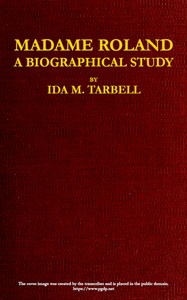
Madame Roland: A Biographical Study — Background and Themes can be approached with a clearer sense of reading commitment from its source measurements: 85,823 words, 6 hr 14 min estimated reading time, and 23 detected text sections.
The text analysis averages about 21.4 words per sentence, while the detected sections provide another way to judge how the source is divided.
Project Gutenberg metadata also associates the work with “France -- History -- Revolution, 1789-1799,” connecting these edition facts with the source record’s subject description.
Explore this collection
These alternatives are selected using recorded categories and estimated reading time.
About 359 minutes
Social History
82,509 recorded words. 15 minutes difference from this book's estimate.
View Gutenberg source #48108About 307 minutes
Social History
70,384 recorded words. 67 minutes difference from this book's estimate.
View Gutenberg source #45810About 268 minutes
Social History
61,530 recorded words. 106 minutes difference from this book's estimate.
View Gutenberg source #52412Search stored excerpts and compare books → Choose by your preferences →
Choices use stored catalog measurements. Estimates vary with reading speed. A shared category is a catalog label, not a claim that two books have the same argument or literary quality.
Search reads excerpt text stored with this catalog and links to its associated Gutenberg record. The connection is stored in the site database; this tool does not recheck that every excerpt is word-for-word identical to that external record. Excerpt search does not cover every chapter and does not verify historical publication dates.
Catalog snapshot checked: 2026-09-25. Coverage: 91 public books, 91 available source excerpts.
Read the complete public-domain text at its original source.
Read on Project GutenbergIda M. Tarbell's Madame Roland: A Biographical Study (1896) opens with a striking methodological claim: the author has used unpublished letters to correct earlier biographers who were 'too ardent republicans' or 'too passionate admirers' to dwell on episodes inconsistent with their heroine's later life. This preface establishes a voice that is both investigative and corrective, promising a portrait grounded in archival evidence rather than hagiography.
The excerpts reveal a narrative that alternates between close psychological analysis and broader political commentary. Tarbell frequently quotes Roland's own words—'I have never been able to believe in the constitutional vocation of a king'—to illustrate her subject's growing intransigence. The prose is dense with judgment, as when Tarbell describes Roland's suspicion as 'a disease' and her self-confidence as a belief that she was 'better than he.' This is not a neutral biography but an argument about the dangers of ideological purity.
Tarbell's preface foregrounds her use of manuscript sources: letters given to the Bibliothèque Nationale in 1888 by Madame Faugère, which had been used by earlier scholars only selectively. She claims these documents reveal a 'very different view' of Roland's courtship and marriage, and a previously untold episode: Roland's search for a title with privileges in Paris in 1784. By highlighting what earlier biographers suppressed, Tarbell positions herself as a corrective historian.
The effect on the narrative voice is twofold. First, it creates an aura of authority: the reader is told that the story that follows is based on evidence, not legend. Second, it introduces a critical distance. Tarbell does not simply recount Roland's life; she evaluates the gaps and distortions in previous accounts. This self-consciousness about sources gives the biography a meta-historical layer, reminding readers that every life story is a construction.
Tarbell's analysis of Roland's political evolution is built on quotations that reveal a hardening ideology. She cites Roland's dismissal of the king as 'a hors d’œuvre' and her refusal to accept the constitutional monarchy because she could not 'believe in the sincerity of the king and court.' The biographer traces this suspicion to a personal grievance: the old régime had 'refused her solicitations although they were just,' and she did not forgive the humiliation.
Tarbell's own voice becomes more interpretive here, using phrases like 'resentful jealousy' and 'a species of that resentful jealousy which distorts certain really superior natures.' The language is clinical, almost diagnostic. She presents Roland's idealism as a 'necessity, an imperative personal need' that blinded her to the people's satisfaction with the constitution. The narrative pace slows as Tarbell dwells on psychological motives, contrasting with the faster, event-driven sections that follow.
When the Rolands arrive in Paris in December 1791, Tarbell shifts to a broader canvas, describing the Girondin deputies who 'had been brought up on Plutarch and Rousseau' and whose 'heads were filled with noble doctrines and drafts of perfect constitutions.' Their speech was 'in classic phrases,' their arguments based on 'what happened in Greece and Rome.' This passage is notable for its economy: Tarbell sketches an entire political culture in a few sentences.
The narrative voice here becomes more reportorial, less judgmental, though the irony is palpable. The Girondins' classical rhetoric is presented as both sincere and naive—a 'draft of perfect constitutions' that would soon collide with revolutionary reality. Tarbell's pacing accelerates, moving from psychological depth to political panorama, and the reader senses the approach of the crisis that will define Roland's fate. The shift in tempo mirrors the historical acceleration of the Revolution itself.
Tarbell's biography rewards readers who attend to its narrative architecture: the alternation between intimate psychological portraiture and sweeping political analysis, the careful use of unpublished letters to unsettle received wisdom, and the critical distance that prevents hagiography. The excerpts suggest a work that is as much about the writing of history as about its subject. Readers should note how Tarbell's own voice—investigative, analytical, occasionally severe—shapes the story she tells, and how her choices of quotation and emphasis create a particular Roland: ambitious, resentful, and tragically self-assured.
I’ve often thought that Madame Roland, who prized her private papers above public spectacle, would have understood the quiet patience of Over Periscope Pond — Inside the Classic—its knowing way of lingering where arguments usually hurry on. Both tell of how we wrestle a self from silent records, then lose it again to history’s noise.
Build a private reading journal entry for this title.