About 224 minutes
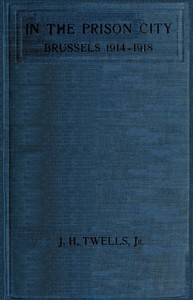
In the Prison City, Brussels, 1914-1918: A Personal Narrative — Reading Companion
Social History
51,416 recorded words. 4 minutes difference from this book's estimate.
View Gutenberg source #55876
Before opening Captivity and Escape — Themes and Context, the edition data offers a quick orientation: 50,434 words, 3 hr 40 min estimated reading time, and 6 detected text sections.
The text analysis averages about 19.4 words per sentence, while the detected sections provide another way to judge how the source is divided.
Project Gutenberg metadata also associates the work with “World War, 1914-1918 -- Prisoners and prisons, German,” connecting these edition facts with the source record’s subject description.
Explore this collection
These alternatives are selected using recorded categories and estimated reading time.
About 224 minutes
Social History
51,416 recorded words. 4 minutes difference from this book's estimate.
View Gutenberg source #55876About 182 minutes
Social History
41,780 recorded words. 38 minutes difference from this book's estimate.
View Gutenberg source #53887About 177 minutes
Social History
40,663 recorded words. 43 minutes difference from this book's estimate.
View Gutenberg source #68451Search stored excerpts and compare books → Choose by your preferences →
Choices use stored catalog measurements. Estimates vary with reading speed. A shared category is a catalog label, not a claim that two books have the same argument or literary quality.
Search reads excerpt text stored with this catalog and links to its associated Gutenberg record. The connection is stored in the site database; this tool does not recheck that every excerpt is word-for-word identical to that external record. Excerpt search does not cover every chapter and does not verify historical publication dates.
Catalog snapshot checked: 2026-09-25. Coverage: 91 public books, 91 available source excerpts.
Read the complete public-domain text at its original source.
Read on Project GutenbergJean Martin's account of his time as a prisoner of war in Germany is built on a series of small, tactical victories against the camp's rigid order. In one episode, prisoners saw off the tops of fence posts for firewood, disguising their work as diligent labor under the approving eyes of German officers. The ruse succeeds because the guards cannot imagine unauthorized initiative; they interpret the activity as a sign of the prisoners' commendable economy. Martin repeatedly shows how the prisoners exploit this gap between German expectation and French ingenuity.
Martin presents a recurring pattern: the prisoners' acts of defiance are not grand escapes but subtle manipulations of camp rules. The sawing of posts is described with mock solemnity—a prisoner measures with a folding measure, murmuring about 'making a good job of it.' The German officers, seeing the men 'diligent and serious,' are pleased, unable to conceive that the work is subversive. Martin explicitly contrasts 'German logic' with 'French logic,' noting that the German mind cannot imagine action without an order. This cultural friction becomes a tool of resistance. The prisoners' joy comes not just from warmth but from having 'done' their jailers. The episode ends with the fires relit, the guards having relaxed their watch, and the prisoners savoring a victory that is both practical and psychological.
The texture of camp life is conveyed through precise, sensory details. A winter morning at 6:30: huts deserted, men queuing for 'half-pints' of a black drink called coffee—actually an infusion of roasted barley, drunk without sugar. The distribution is a tightly controlled ritual: each man passes between two sergeants who count and recognize him; the ration is exactly measured. Martin's description of the 'thin column of steam' rising from a bucket and the 'impatient crowd' signals the meagerness of the meal. The word 'Frühstuck' is given in German, a small marker of the foreign environment. These details accumulate to show a world governed by scarcity and surveillance, where even a hot drink is a prize.
Martin's position as interpreter for British soldiers gives him a unique vantage point. The preface notes that he was appointed to this role because of his knowledge of English, and that he used postcards to inform British families of the prisoners' condition. This dual role—both prisoner and intermediary—shapes his narrative. He observes the camp from within and across national lines. The dedication to his fiancée, 'the thought of whom brought consolation,' hints at a personal thread that runs beneath the collective story. The preface also reveals that Martin was awarded the Croix de Guerre and cited for his actions, but the excerpts focus on the communal, not the heroic. His escape to Holland in July 1915 is mentioned only as a fact, not dramatized.
Readers should attend to the way Martin uses humor and understatement to describe conditions that are often brutal. The narrative does not dwell on suffering but on the prisoners' capacity to create small pockets of autonomy. The episodes are self-contained, each a vignette of wit and endurance. Martin's perspective as a French soldier among British allies adds a layer of cross-cultural observation that enriches the account of captivity.
There’s something about Jean Martin’s careful inventory of small victories—a mended shirt, a hidden map—that stays with me long after closing. His escape feels almost incidental to the daily stubbornness he records. Reading his account, I found myself thinking of that other volume, German Atrocities: Their Nature and Philosophy — Text and Context, and how differently the same war looks from across a desk. Both are true, somehow, in their separate ways.
Build a private reading journal entry for this title.