About 816 minutes
The War History of the 4th Battalion, the London Regiment (Royal Fusiliers), 1914-1919 — Key Ideas to Explore
Modern Nations
187,612 recorded words. 104 minutes difference from this book's estimate.
View Gutenberg source #50098
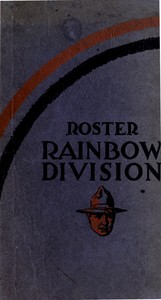
Before opening Roster of the Rainbow division (Forty-Second) Major General Wm. A. Mann commanding — Text and Context, the edition data offers a quick orientation: 211,408 words, 15 hr 20 min estimated reading time, and 33 detected text sections.
The text analysis averages about 3.3 words per sentence, while the detected sections provide another way to judge how the source is divided.
Project Gutenberg metadata also associates the work with “United States. Army. Infantry Division, 42nd,” connecting these edition facts with the source record’s subject description.
Explore this collection
These alternatives are selected using recorded categories and estimated reading time.
About 816 minutes
Modern Nations
187,612 recorded words. 104 minutes difference from this book's estimate.
View Gutenberg source #50098About 661 minutes
Modern Nations
151,966 recorded words. 259 minutes difference from this book's estimate.
View Gutenberg source #61769About 614 minutes
Modern Nations
141,100 recorded words. 306 minutes difference from this book's estimate.
View Gutenberg source #63596Search stored excerpts and compare books → Choose by your preferences →
Choices use stored catalog measurements. Estimates vary with reading speed. A shared category is a catalog label, not a claim that two books have the same argument or literary quality.
Search reads excerpt text stored with this catalog and links to its associated Gutenberg record. The connection is stored in the site database; this tool does not recheck that every excerpt is word-for-word identical to that external record. Excerpt search does not cover every chapter and does not verify historical publication dates.
Catalog snapshot checked: 2026-09-25. Coverage: 91 public books, 91 available source excerpts.
Read the complete public-domain text at its original source.
Read on Project GutenbergLieutenant Harold Stanley Johnson compiled this roster in October 1917, while the 42nd Division mobilized at Camp Mills, Long Island. The foreword explains that after three weeks in camp, officers and men sought to know their co-workers, and Johnson undertook the compilation to foster coordination. The division, christened the Rainbow by Secretary of War Baker, drew units from 26 states, from coast to coast and Maine to the Gulf. Johnson notes that most chosen units had seen service in the Spanish-American War or border troubles, framing selection as an honor.
The roster is organized by unit, beginning with division headquarters and proceeding through artillery, infantry, and support branches. Each entry typically includes name, rank, and home address. For example, the 117th Field Signal Battalion from Missouri is listed, as are the 117th Ammunition Train from Kansas and the 117th Supply Train from Texas. The 149th Machine Gun Battalion hails from Pennsylvania. This geographic diversity is central to the division's identity.
Johnson's foreword employs a formal yet earnest tone. He writes of the “great desire” for acquaintance and the “necessity of personal contact” for efficiency. The phrase “co-ordination of each branch of the service into a unit of the highest possible efficiency” reveals a bureaucratic precision. He credits Major-General Mann, Colonel MacArthur, and the Statistical Department, emphasizing institutional cooperation. The closing line, “May its career be as brilliant as the rainbow itself,” uses a simile that ties the division's name to aspiration.
The home addresses in the roster offer a snapshot of early 20th-century America. Soldiers from New York City list streets like 173 E. 90th St. and 108 E. 81st St., while others come from small towns: Olean, New York; Matamoras, Pennsylvania; East Liberty, Pennsylvania. Some addresses include rural routes or post office boxes. A few soldiers give Irish origins, such as “Labasheeda, Co. Clare, Ireland.” These details ground the division in specific communities.
The entries show a hierarchy of ranks: privates, privates first class, corporals, sergeants, and first sergeants. Special roles appear, such as “Cook” for Michael J. O’Brien. The roster includes ordnance detachments and engineer trains, indicating the division's logistical breadth. The 117th Engineer Regiment draws from South Carolina and California, while the 117th Engineer Train comes from North Carolina. This mix of states and roles underscores the Rainbow Division's composite nature.
Readers should approach this roster as a primary document of military organization and social history. The names and addresses are not mere data but traces of individual lives converging in a single division. Johnson's compilation, though utilitarian, reveals the deliberate assembly of a national force. The foreword's emphasis on efficiency and honor frames the list as both a practical tool and a patriotic statement.
There’s something humbling about those old lists—names, ranks, addresses—all those lives folded into a page. I kept thinking about that while reading The Tunnellers of Holzminden (with a side-issue) — Text and Context. It felt less like history and more like a quiet room where someone left the lights on, holding a breath I hadn’t expected to remember.
Answer a few questions and save a private reflection on this device.