
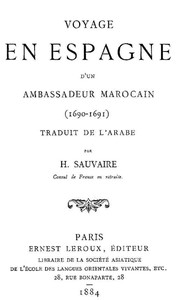
Voyage en Espagne d'un Ambassadeur Marocain (1690-1691) by Wazir al-Ghassani
In 1690, the Moroccan Sultan Moulay Ismail sent his ambassador, Muhammad al-Ghassani, on a sensitive mission to the court of King Charles II of Spain. The goal was practical: to negotiate the ransom and release of Muslim captives held by the Spanish. But the setting was charged with history. Just a century before, Spain had completed the Reconquista and expelled its Muslim population. Al-Ghassani was walking into a land that had systematically erased the visible presence of his faith and culture.
The Story
This book is al-Ghassani's personal travelogue. He documents his journey from the Moroccan coast, across the Strait of Gibraltar, and through the Spanish countryside to Madrid and back. He doesn't just list events; he paints pictures. He describes the landscapes, the cities, and the state of the roads. He notes the crumbling remnants of mosques turned into churches and listens to local legends about the 'Moors' who once lived there. The heart of the narrative is his time at the Spanish court. We see his diplomatic meetings, the elaborate ceremonies, and the constant undercurrent of political tension. He observes Spanish customs with a curious but critical eye, comparing everything from their food and fashion to their military tactics with what he knows back home.
Why You Should Read It
What makes this book so gripping is its intimate, ground-level view. This isn't a grand political history; it's the story of one man trying to do his job in a foreign and sometimes hostile land. Al-Ghassani comes across as witty, perceptive, and resilient. You feel his loneliness and his pride. He's fascinated by Spanish technology and architecture, but also shocked by what he sees as their social customs. Reading his observations flips the script on the usual European travel narrative. Here, Europe is the exotic, strange land being scrutinized. It completely changes how you think about cultural contact and power in this era.
Final Verdict
Perfect for anyone who loves real-life adventure stories, armchair travelers, and readers hungry for non-Western perspectives on history. If you enjoyed the personal detail of Samuel Pepys's diary or the cross-cultural observations in Marco Polo's travels, you'll love this. It’s a short, powerful reminder that the past was never just one story, and that even in times of great conflict, people were still people—observant, curious, and trying to make sense of each other.
You are viewing a work that belongs to the global public domain. Access is open to everyone around the world.
Amanda Williams
1 year agoCitation worthy content.
Donna Ramirez
1 year agoVery interesting perspective.
Andrew Lee
1 year agoClear and concise.
Andrew White
1 year agoAs someone who reads a lot, the content flows smoothly from one chapter to the next. Thanks for sharing this review.









Michelle White
4 months agoRecommended.