
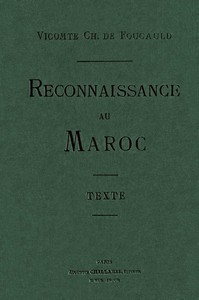
Reconnaissance au Maroc, 1883-1884 (Texte) by Charles de Foucauld
Let's set the scene: It's 1883, and Morocco is a mystery to Europe. Its mountainous interior is a 'no-go' zone for foreigners, especially Christians. Enter Charles de Foucauld. He's not a priest yet—far from it. He's a 25-year-old French cavalry officer with a reputation for partying and a career in ruins. To salvage his standing, he volunteers for a near-suicidal mission: travel across Morocco and make a detailed map for the French army. His plan is as bold as it is crazy. He shaves his head, learns some Hebrew and Arabic, and poses as 'Rabbi Joseph,' a destitute Jewish doctor and trader. With his real-life companion, a Jewish scholar named Mordechai, he sets off on a year-long journey through the heart of the country.
The Story
The 'plot' is his journey. There's no traditional narrative arc, just the relentless pressure of survival. We follow him from city to city—Fez, Meknes, Marrakesh—always moving, always watching. The drama is in the details: haggling for food, finding a safe place to sleep, dealing with corrupt officials, and constantly adjusting his disguise. He meticulously records everything: geography, tribal structures, military fortifications, market prices. The threat of exposure is a constant companion. One wrong prayer, one slip of the tongue in Arabic, and his mission—and his life—would be over. It's a ground-level view of a complex society, seen through the anxious eyes of an outsider pretending to be a different kind of outsider.
Why You Should Read It
This book strips away all the romance of exploration. There's no glory here, just dust, fear, and exhausting work. What makes it gripping is Foucauld's voice. You feel his loneliness, his sharp observations, and his growing respect for the people he meets, even as he's deceiving them. It's a paradox: a document of colonial espionage that also reveals the richness of Moroccan life. You get the clatter of souks, the stark beauty of the landscape, and the intricate social codes he must navigate. It's a powerful reminder that history is lived by people making difficult, often ethically messy, choices one day at a time.
Final Verdict
Perfect for readers who love real adventure stories and immersive history. If you enjoyed the tense travels in books like Thesiger's 'Arabian Sands' or the ethnographic detail of Geertz's work, but want a raw, personal account from the 19th century, this is for you. It's not a light read—it's dense with observation—but it's a captivating look at a world on the brink of change, written by a fascinatingly flawed character long before he became a saint. Think of it as the ultimate travel blog from a time before blogs, where the stakes couldn't be higher.
This content is free to share and distribute. Use this text in your own projects freely.
Jessica Martinez
4 months agoGiven the current trends in this field, the wealth of information provided exceeds the average market standard. Highly recommended for those seeking credible information.
Paul Anderson
9 months agoComparing this to other titles in the same genre, the formatting on mobile devices is surprisingly crisp and clear. I feel much more confident in my knowledge after finishing this.
Nancy Hernandez
1 month agoI was skeptical about the depth of this book at first, but the transition between theoretical knowledge and practical application is seamless. I'll be citing this in my upcoming project.
Robert Moore
2 years agoGiven the current trends in this field, the inclusion of diverse viewpoints strengthens the overall narrative. It definitely lives up to the reputation of the publisher.








Jennifer Wilson
1 month agoGreat value and very well written.