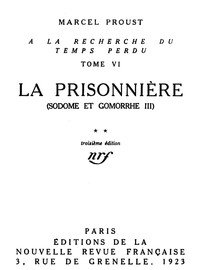
La Prisonnière (Sodome et Gomorrhe III) by Marcel Proust
Welcome back to the world of Marcel Proust, where a single memory can take twenty pages and a social slight can feel like a world war. 'La Prisonnière' ('The Captive') is the fifth volume of In Search of Lost Time, and it’s where the story turns inward, getting uncomfortably close and personal.
The Story
The plot is simple, but the feelings are enormous. Our narrator, Marcel, has brought his girlfriend, Albertine, to live with him in his family's Paris apartment. You'd think this would be romantic bliss. It's not. Marcel is consumed by a jealous suspicion that Albertine, who has hinted at relationships with other women in her past, is being unfaithful. He doesn't confront her directly. Instead, he becomes a warden. He uses his family's wealth and social position to keep her dependent, buying her expensive gifts to make her stay while hiring people to follow her when she goes out. The entire book takes place in this tense, airless apartment, as Marcel dissects Albertine's every sigh, her casual remarks, and her unexplained absences, searching for proof of a betrayal he's already convinced has happened.
Why You Should Read It
This book is a masterclass in psychological realism. Proust isn't telling a story about spies or detectives; he's showing us how we become spies and detectives in our own relationships. Have you ever overanalyzed a text message or replayed a conversation looking for hidden meaning? Marcel does that for 400 pages, and it’s agonizingly familiar. The 'prison' of the title isn't just Albertine's—it's Marcel's. He's trapped by his own mind, by his need to possess and know another person completely, which is an impossible task. Reading it feels like watching a slow-motion car crash of a relationship, and Proust makes you understand both the driver and the passenger.
Final Verdict
This is not the book to start your Proust journey with—jump in with Swann's Way first. But for readers already traveling through his masterpiece, 'La Prisonnière' is a stunning, difficult, and essential stop. It’s perfect for anyone who loves character studies that feel truer than real life, or for anyone who has ever felt love twist into something darker. It’s a book that holds a mirror up to our own insecurities and asks, 'How well do we really know anyone, especially the people we love?' Be prepared: it’s a long, slow, and profoundly brilliant look into the heart's darkest corners.
No rights are reserved for this publication. You do not need permission to reproduce this work.