
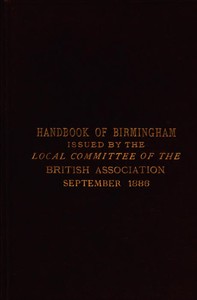
Handbook of Birmingham by British Association for the Advancement of Science
Forget plot twists and characters—this book’s drama is all real. Published in 1886, it was a guide created by the British Association for the Advancement of Science for its members visiting their annual meeting in Birmingham.
The Story
The 'story' here is the city itself. The book is organized like a detailed report, splitting Birmingham into sections. One chapter lays out its explosive growth from a market town to 'The Workshop of the World.' Another dives deep into its industries, from the famous metalworking to the growing chemical trades. It doesn’t stop at economics, though. It covers local government, education, parks, libraries, and even the city's challenges with public health and housing. It’s a full-body scan of a living, breathing, and often smoking, Victorian metropolis. The narrative is the tension between proud celebration of progress and clear-eyed analysis of the problems that progress created.
Why You Should Read It
This is where it gets cool. Reading this isn't about memorizing facts. It’s about eavesdropping on a conversation from 140 years ago. You get the distinct voice of late-Victorian expertise—confident, curious, and convinced that careful study can fix anything. The details are astonishing. You’ll learn how many miles of gas pipes were under the streets, what was taught in the new technical schools, and how the local council was tackling slums. It makes you see the modern city in a whole new light. Every old building or street name suddenly has a backstory rooted in this era of frantic invention and reform.
Final Verdict
This is a niche read, but a fascinating one. It’s perfect for anyone with a deep love for Birmingham’s history, for students of the Industrial Revolution who want a primary source that’s not just about machines but about society, or for local history buffs anywhere who want to see how a great city was documented at its moment of triumph. It’s not a beach read, but for the right person, it’s a captivating portal straight into the noisy, innovative, and complicated heart of Victorian England.
This text is dedicated to the public domain. It serves as a testament to our shared literary heritage.
Mason Martinez
1 year agoI didn't expect much, but the plot twists are genuinely surprising. I will read more from this author.
Michelle Wright
3 months agoNot bad at all.
James Sanchez
6 months agoLoved it.
Betty Garcia
1 year agoIf you enjoy this genre, it challenges the reader's perspective in an intellectual way. Exactly what I needed.




Ava Clark
1 year agoTo be perfectly clear, the depth of research presented here is truly commendable. I couldn't put it down.